When we first start building with AI, most of us do the exact same thing: we grab an API key from OpenAI or Anthropic, write a few prompts, and call it a day. And for a lot of projects, that works perfectly. But as you cross into building more complex, production-ready apps, you quickly realize that simple prompts can only take you so far. Eventually, you hit a wall where the model just isn't getting your brand's voice, formatting things wrong, or lacking specialized knowledge. That is where fine-tuning comes in.
TL;DR — Fine-tuning is not the right tool for most LLM problems. RAG beats fine-tuning when the knowledge changes frequently. Fine-tuning wins when you need consistent format, tone, or domain-specific reasoning patterns.
The Big Picture: Pre-Training vs. Post-Training
To understand fine-tuning, you have to look at the two life stages of an AI model:
- Pre-Training (The Heavy Lifting): This is what companies like Google, Meta, or OpenAI do. They take massive clusters of expensive supercomputers and feed the model trillions of words from the internet. This creates a "Base Model." It knows how language works, but it isn't specialized in anything yet.
- Post-Training (Our Job): This is where we take that base model and give it extra training on a smaller, specific dataset. We aren't teaching it how to speak from scratch; we are teaching it how to follow specific rules, adopt a unique tone, or understand a niche industry.
Open-Weight vs. Closed-Source
How you fine-tune depends on the model you choose:
- Open-Weight (Like Llama or Mistral): The blueprints and internal "weights" of the model are public. You can download it, tweak it, and run it on your own servers.
- Closed-Source (Like GPT-4 or Gemini): The weights are locked behind a vault. If you want to fine-tune them, you have to use their official website/platform, upload your data to their cloud, and let them handle it. You don't get to see what happens behind the scenes.
Making it Affordable: What is PEFT, LoRA, and QLoRA?
In traditional software, updating code is easy. But modern AI models have billions of internal settings (called parameters). Changing every single one of them requires an insane amount of computing power and millions of dollars.
To solve this, engineers use PEFT (Parameter-Efficient Fine-Tuning). The most popular methods are:
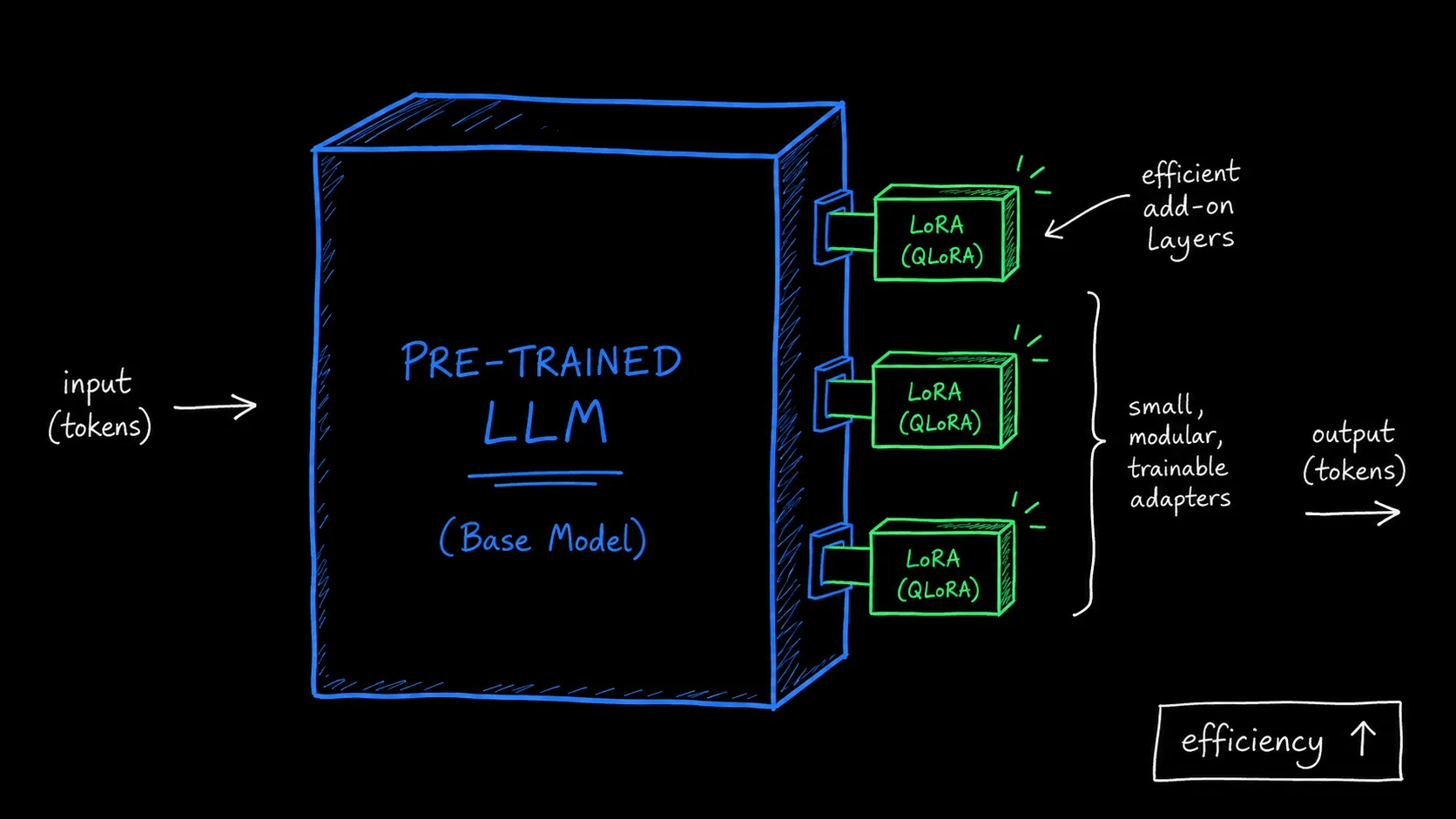
- LoRA (Low-Rank Adaptation): Instead of changing all 70 billion settings in a model, LoRA freezes the original model completely. Then, it plugs a few small, blank "add-on" layers into the model and only trains those. It saves a massive amount of memory and cost.
- QLoRA (Quantized LoRA): This takes efficiency a step further. It shrinks the size of the base model (like compressing a high-res video so it plays smoothly on a phone) and then applies LoRA. Today, QLoRA is the go-to starting point for most development teams because it lets you fine-tune powerful models on a single, affordable graphics card.
QLoRA is the breakthrough that made fine-tuning accessible. Before it, you needed a data center. Now you need a decent GPU and a few hours.
Teaching the Model What We Like
Lately, fine-tuning has evolved past just giving a model a bunch of text to memorize. We now use Reinforcement Learning to teach it human preferences. Three terms you will hear a lot are:
- 01Verifiable Rewards: This is used for models that need to "think" or reason (like solving math or code). If the model writes a piece of code that works, it gets a digital "reward." If the code fails, it gets penalized. The model essentially practices by itself until it gets smarter.
- 02RLHF (Human Feedback): Humans look at two different answers from the AI, pick the better one, and teach a separate "reward AI" what humans prefer. It's powerful but incredibly slow and expensive.
- 03DPO (Direct Preference Optimization): A much simpler, newer shortcut. Instead of building a separate reward system, DPO directly shows the AI pairs of "good" and "bad" answers in one single step. It's faster, cheaper, and has become the default choice for open-source projects.
The Tactical Game Plan
If you're looking to improve your AI app's performance, don't jump straight into fine-tuning. Follow this checklist first:
- 01Fix your prompts: Try to get 80% of the way there just by writing better, clearer instructions.
- 02Fix your data (RAG): Connect your model to a solid database so it has the right context.
- 03Use QLoRA: If the AI still struggles with your specific tone, style, or highly niche industry knowledge, it's time to build a QLoRA pipeline.
- 04Use DPO: Use this if you need to strictly align the AI's behavior, safety limits, or conversational nuances with human tastes.
A Final Reality Check
Fine-tuning is a multiplier. If you feed a great AI model a messy, low-quality dataset, you will actually make the model worse, not better. Before you write a single line of training code, make sure your data is clean, organized, and that you have a clear way to test if your changes actually improved the app.
The best fine-tuning is the one you don't do. Exhaust simpler approaches first — better prompts and better data usually solve 90% of your problems.
Need an AI engineer for your project? I build RAG systems, LLM integrations, AI agents, and SaaS backends. Reach me at prayagbagthariya.vercel.app/hire-me or prayag129787@gmail.com.
Frequently Asked Questions
What is LLM fine-tuning and when do I actually need it?
Fine-tuning is the process of taking a pre-trained LLM and continuing its training on a smaller, domain-specific dataset to adjust its behavior, tone, or knowledge. You need it when prompt engineering consistently fails to produce the right output format, brand voice, or specialized domain responses — and when you have enough high-quality examples (typically 100–1000+) to train on. Most developers reach for fine-tuning too early; exhaust prompting and RAG first.
What is the difference between fine-tuning and RAG?
RAG (Retrieval-Augmented Generation) gives the model access to external documents at inference time — it's about what the model can look up. Fine-tuning changes the model's weights — it's about how the model thinks and responds. RAG is better for keeping responses current with changing information. Fine-tuning is better for consistent tone, format, and behavior patterns that should apply across all responses regardless of retrieved context.
What is LoRA and why is it the preferred fine-tuning method?
LoRA (Low-Rank Adaptation) fine-tunes only a small set of adapter weights rather than all of the model's parameters. This makes fine-tuning feasible on consumer hardware, dramatically reduces training cost, and prevents catastrophic forgetting — where the model loses its general capabilities while learning the new specialized ones. Most production fine-tuning today uses LoRA or its variants (QLoRA, AdaLoRA).
How much training data do I need for LLM fine-tuning?
It depends on the task complexity. For simple format or tone adjustments, 100–500 high-quality examples can be enough. For domain-specific knowledge, 1,000–10,000 examples are more typical. Quality matters far more than quantity — a messy dataset of 10,000 examples will underperform a clean, consistent dataset of 500. Every training example should represent exactly the input-output behavior you want the model to learn.
How do I measure whether fine-tuning actually improved my model?
Define your evaluation metrics before training, not after. For factual tasks, use accuracy on a held-out test set. For generative tasks (tone, style), use a combination of human evaluation and automated scoring with a judge LLM. Always compare against your baseline (the untuned model with your best prompt) — fine-tuning only wins if it outperforms your best prompt engineering effort on the same task.
Continue reading
Get updates directly in your Google Search feed
Add this publication as a preferred source to highlight articles in Top Stories and AI Overviews.