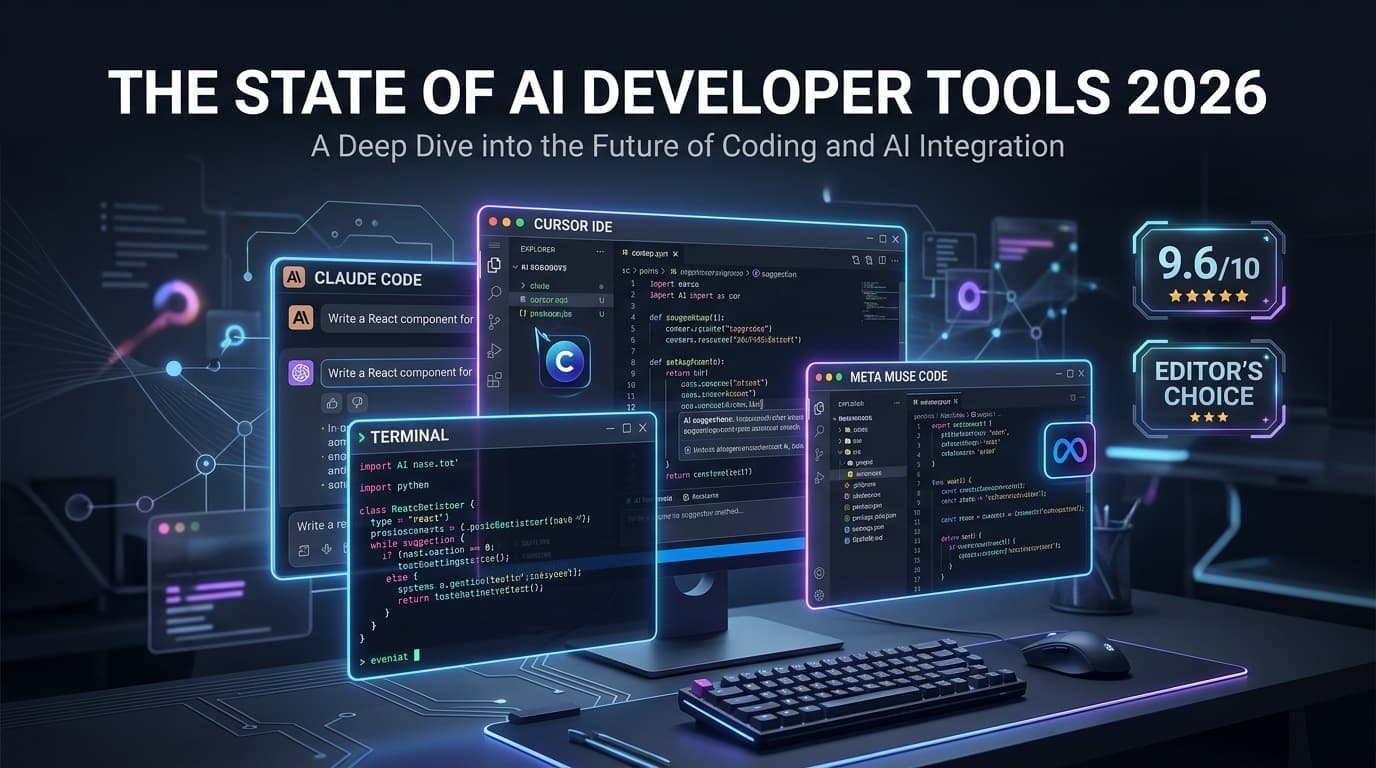
The software engineering ecosystem hit a massive inflection point in August 2026. We've officially transitioned from the era of simple inline code completion tools ('AI assistants') to full-blown autonomous 'AI coding agents' capable of reading entire codebases, running terminal commands, executing test suites, and fixing bugs asynchronously. With Meta launching Muse Code and Anthropic's Claude Code cementing its lead among senior engineers, choosing the right AI developer stack has never been more critical. In this comprehensive review, we benchmarked and ranked the leading tools out of 10.
Top Pick (9.6/10): Claude Code dominates terminal-first agentic workflows with unmatched codebase reasoning, sub-agent spawning, and tool integration.
1. Claude Code — Score: 9.6 / 10 (Winner)
Anthropic's terminal-native tool has established itself as the gold standard for senior developers and staff engineers. Unlike traditional IDE plugins, Claude Code operates directly inside your CLI with full permission boundary control, execution loop feedback, and multi-agent coordination.
- Strengths: Deep context retention across massive multi-repo setups, low hallucination rate on tool parameters, built-in security auditing plugins, and flawless git integration.
- Weaknesses: Higher API cost for long-running continuous agent sessions; requires command-line familiarity.
- Best For: Complex refactoring, architecture redesigns, multi-file bug fixing, and backend engineering.
2. Cursor IDE — Score: 9.2 / 10
Cursor remains the undisputed king of AI-native IDEs. By embedding custom indexing and model routing into a VS Code fork, Cursor delivers frictionless multi-file edits with instant inline diff previews.
- Strengths: Incredible visual UI/UX, instant codebase indexing (Semantic & CodeGraph support), effortless inline generation and keybinding integration.
- Weaknesses: Can occasionally feel bloated on massive monorepos compared to terminal-native tools.
- Best For: Frontend engineering, UI prototyping, fast daily coding, and interactive pair programming.
3. Meta Muse Code — Score: 8.7 / 10
Launched in August 2026, Meta's Muse Code introduces a unique pay-as-you-go terminal agent powered by the Muse Spark 1.2 model. It excels in persistent activity logs and long-duration asynchronous tasks.
- Strengths: Strong persistent state tracking across multi-hour tasks, cost-effective pay-as-you-go billing model.
- Weaknesses: Ecosystem plugins are still maturing; slightly higher latency on initial task planning.
- Best For: Background maintenance, automated test generation, and large-scale repository audits.
4. Cline (Open Source) — Score: 8.4 / 10
The favorite among open-source enthusiasts and privacy-conscious organizations. Cline allows developers to bring their own API keys or local LLM endpoints (Ollama/LM Studio) while retaining agentic file editing capabilities.
- Strengths: 100% open source, zero vendor lock-in, customizable system prompts and custom tool extensions.
- Weaknesses: Requires setup tuning; output quality heavily dependent on the chosen backend model.
- Best For: Privacy-strict enterprise teams and open-source hacker setups.
5. GitHub Copilot — Score: 7.9 / 10
While Copilot introduced millions of developers to AI coding, its traditional inline autocomplete architecture lags behind the newer autonomous agent-first tools in complex multi-file engineering tasks.
- Strengths: Seamless GitHub ecosystem integration, enterprise policy compliance, fast inline tab completions.
- Weaknesses: Limited autonomous multi-step reasoning and terminal tool execution capabilities.
- Best For: Standard code completion and enterprise teams requiring strict centralized compliance.
Comparative Score Summary Matrix
| Developer Tool | Overall Score | Codebase Reasoning | Agent Autonomy | Value / Price |
| :--- | :--- | :--- | :--- | :--- |
| **Claude Code** | **9.6 / 10** | 9.8 / 10 | 9.7 / 10 | 9.0 / 10 |
| **Cursor IDE** | **9.2 / 10** | 9.3 / 10 | 9.0 / 10 | 9.3 / 10 |
| **Meta Muse Code** | **8.7 / 10** | 8.8 / 10 | 8.9 / 10 | 8.5 / 10 |
| **Cline (Open Source)**| **8.4 / 10** | 8.2 / 10 | 8.5 / 10 | 9.5 / 10 |
| **GitHub Copilot** | **7.9 / 10** | 7.5 / 10 | 7.0 / 10 | 8.8 / 10 |Frequently Asked Questions
Which AI tool should I choose in 2026?
If you work heavily in terminal environments and manage complex backend codebases, Claude Code (9.6/10) is currently unmatched. For visual frontend engineering and smooth VS Code integration, Cursor IDE (9.2/10) remains top tier.
Are inline AI copilots obsolete?
Not obsolete, but their role has shifted. Inline autocomplete is now considered a baseline capability; the real productivity gains come from autonomous agents that plan, run tests, and refactor whole features.
Continue reading


Get updates directly in your Google Search feed
Add this publication as a preferred source to highlight articles in Top Stories and AI Overviews.