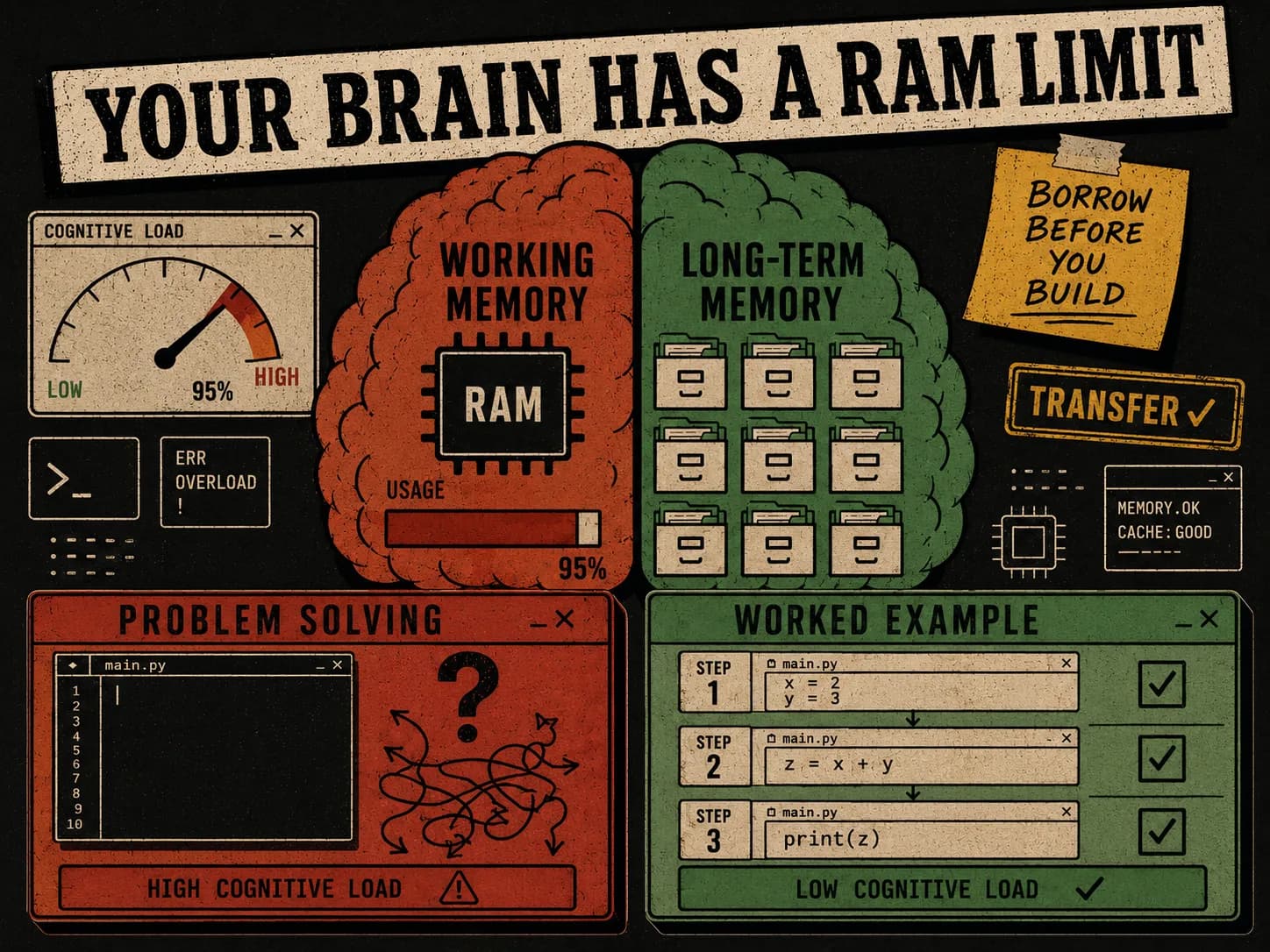
I used to think the fastest way to get better at coding was to just build stuff. Jump in, break things, Google the errors, repeat. And honestly? That works... eventually. But it always felt exhausting. I'd spend hours stuck on step one of a problem before I even understood the shape of the solution. Then I stumbled across research on something called the worked example effect — and it completely changed how I approach learning as a developer.
TL;DR — Reading and dissecting real production code is faster than any tutorial. Patterns absorbed from real codebases are immediately transferable. Studying how senior engineers solved the same problem is the highest-ROI learning activity.
What Are Worked Examples, and Why Should You Care?
A worked example is simply a solved problem with every step shown. In education research, this is usually studied in math classrooms. But as a developer, you encounter worked examples every single day — you just don't call them that.
- A well-written tutorial that walks you through building a REST API
- A GitHub repo with clean, readable code showing how to implement authentication
- A code review comment that rewrites your function with an explanation
- A Stack Overflow answer that doesn't just give you the answer, but shows you why
A 2023 study published in Educational Psychology (Chen, Retnowati, Chan & Kalyuga) ran a controlled experiment comparing two groups of learners. Group 1 studied worked examples — they were shown complete, step-by-step solutions. Group 2 tried to solve the same problems themselves from scratch. The results were pretty clear. Group 1 scored significantly higher — not just on problems similar to what they studied (retention), but also on structurally different problems they had never seen before (transfer). They retained more, learned faster, and felt less overwhelmed throughout. That last part matters more than it sounds.
Your Brain Has a RAM Limit — And You're Probably Maxing It Out
The research is grounded in Cognitive Load Theory (CLT). Here's the core idea: your working memory — the part of your brain doing active thinking right now — can only hold a few things at once. It's like RAM. When you overload it, performance tanks.
When you're a beginner and you try to solve a complex problem from scratch, your brain is doing way too much at once: figuring out what the problem is asking, remembering syntax you half-learned last week, deciding which approach to take, and holding all the previous steps in your head while working on the current one.
That's cognitive overload. And overloaded learners don't just struggle — they fail to encode the knowledge properly, which means they have to relearn the same stuff over and over.
Worked examples fix this. When you already have the solution in front of you, your brain shifts from generating answers to understanding patterns. That's a much more efficient use of your limited working memory, and it frees up mental space to actually absorb how the solution works. The study confirmed this step by step (literally). Students who studied worked examples reported significantly lower mental effort at each stage of the problem — and their scores reflected it.
The Middle Step Problem: Why Mid-Task Is the Hardest Part
Here's something the research found that surprised me, and I think it maps perfectly onto developer experience. You might assume cognitive load gradually decreases as you work through a problem — step one is hardest, step three is easiest. But the data showed something different: the middle step was actually the most cognitively demanding, both for cognitive load and for how challenging learners found it.
The researchers explained this: the middle of a problem is connected to what came before and what comes after. Your brain has to hold those relationships simultaneously while also doing the current calculation. Sound familiar? Think about implementing a feature that sits between your database layer and your UI. You're not just writing code — you're mentally juggling the data model behind you, the component consuming your output in front of you, and the transformation logic right in front of you. That middle layer is where developers get stuck the most, and where good examples help the most.
The study found that worked examples had the strongest beneficial effect at exactly that middle step. Seeing a complete solution doesn't just help at the start — it's most valuable when complexity peaks.
"But I Learn Better by Doing"
I've said this myself. A lot of developers say it. And there's truth in it — you do need to eventually write code yourself. But here's what the research actually says about that tradeoff.
The problem-solving group in this study weren't lazy. They were actively engaged, working through real problems. But because they were spending all their cognitive energy generating solutions, they had less capacity left over for understanding the underlying principles. They were working harder and learning less.
The worked example group, on the other hand, used that freed-up cognitive capacity to focus on structure and patterns — which is exactly what you need when you face a problem you've never seen before. This is what the researchers call knowledge transfer: the ability to apply what you know to new, different situations. And the worked example group outperformed on transfer tests too. Not by a massive margin, but statistically significant — and meaningful.
The goal isn't to memorize solutions to specific problems. It's to develop the mental models that let you tackle any problem in a domain. Worked examples get you there faster.
The Expertise Reversal Effect: When Examples Stop Helping
Here's where it gets nuanced, and this part is important if you're a more experienced developer. The research also describes something called the expertise reversal effect. Once you've built solid knowledge in a domain, worked examples lose their advantage — and in some cases, they actually slow you down.
Think about it: if you already know how to set up a Next.js project, reading through a beginner tutorial isn't going to help you. It's just noise. The cognitive overhead of filtering out what you already know outweighs any benefit.
This means your learning strategy should change as you grow:
- Junior developer: Slow down. Read more examples. Study well-written codebases. Don't rush to build from scratch.
- Mid-level developer: Mix it up. Study examples for unfamiliar patterns, but jump straight into problems for areas you already have a foothold in.
- Senior developer: In your area of expertise, you often learn faster by doing. But in a new domain? You're a beginner again — act like one.
Self-awareness about where you sit on the expertise spectrum for any given topic is genuinely one of the most underrated developer skills.
Practical Ways to Apply This Starting Today
You don't need to overhaul how you work. Small shifts in how you approach learning can have a real compounding effect.
Read code before you write it
Before starting a new feature or picking up an unfamiliar library, find a solid, working implementation and understand it deeply first. GitHub, well-maintained open source projects, and official examples are gold.
Study code reviews like case studies
When a senior dev leaves a comment that rewrites something, don't just click accept. Read the new version line by line and ask yourself why each change was made. That's a worked example right there.
Slow down in tutorials — especially in the middle
When you hit step 3 of 5 in a tutorial, don't skim it. The research suggests that's where the most cognitive complexity lives, and it's where the deepest understanding gets built.
When onboarding juniors, front-load examples
If you're helping someone learn, show them the full solution for the first few tasks before asking them to figure it out themselves. It's not hand-holding — it's how learning actually works.
Give yourself permission to copy before you create
Early in a new domain, copying and adapting clean, working code is not cheating. It's exactly what your brain is designed to do. The research calls it 'borrowing and reorganising' — you're building schemas you can later apply independently.
The Takeaway
We have this cultural bias in software development that struggling through problems from scratch is the noble path. And there's something to that — practice matters, and you do need reps. But the science is pretty clear: for anyone learning something new, worked examples outperform blind problem-solving — on both remembering the material and transferring it to new situations. The cognitive load reduction isn't a crutch, it's what makes room in your brain for the actual learning to happen.
You're not less of a developer for reading the solution first. You might just be a smarter learner.
Based on: Chen, O., Retnowati, E., Chan, B.K.Y., & Kalyuga, S. (2023). The effect of worked examples on learning solution steps and knowledge transfer. Educational Psychology, 43(8), 914–928.
Need an AI engineer for your project? I build RAG systems, LLM integrations, AI agents, and SaaS backends. Reach me at prayagbagthariya.vercel.app/hire-me or prayag129787@gmail.com.
Frequently Asked Questions
What is the worked example effect and why does it matter for learning to code?
The worked example effect is a well-documented finding in cognitive science: studying complete, step-by-step solutions produces better learning outcomes than attempting to solve problems from scratch, particularly for beginners. For developers, this means reading well-written code, following tutorials that show full implementations, and studying code reviews produces deeper understanding with less cognitive effort than jumping straight into building.
Is it bad practice to copy and study code examples when learning programming?
No — and the science backs this up. Copying and studying working code examples is exactly how the brain builds the schemas (mental patterns) needed for independent problem solving. Research by Chen et al. (2023) confirmed that learners who studied worked examples not only retained knowledge better but also transferred it to new, unseen problems more effectively than those who only practiced from scratch.
What is cognitive load and how does it impact a developer's ability to learn new concepts?
Cognitive load is the mental effort required by working memory — the limited-capacity part of your brain that handles active thinking. When you're learning something new and complex, high cognitive load from generating solutions leaves little capacity for actually understanding patterns and principles. Worked examples reduce this load, freeing up working memory to focus on the structural understanding that enables knowledge transfer.
When should a developer stop studying examples and start building things independently?
When you can predict the next step in an example before seeing it, and when you can explain why each step is taken — not just what it does. This is the point at which the cognitive load of the material has dropped enough that independent practice adds more value than continued example study. The expertise reversal effect shows that beyond this point, examples can actually slow you down.
What is the expertise reversal effect and how does it apply to senior developers?
The expertise reversal effect describes how instructional methods that benefit beginners become ineffective or counterproductive for experts. For senior developers, studying beginner tutorials in their area of expertise wastes cognitive resources filtering out what they already know. The practical implication: match your learning approach to your expertise level per domain — a senior React developer who's new to Rust should treat Rust learning like a complete beginner and front-load worked examples.
Continue reading

Get updates directly in your Google Search feed
Add this publication as a preferred source to highlight articles in Top Stories and AI Overviews.