
Every few months, an ambitious engineer posts a viral thread on X or Reddit asking: 'Why on earth is enterprise finance and insurance still built on Java? Why hasn't anyone rewritten the entire core in Rust, Go, or a sleek Node.js microservice?' It sounds intuitive on Twitter. We love hype. We love modern tooling. We love rewriting things from scratch.
The Reality Check: An insurance company is not an e-commerce checkout or a social feed. It is a regulated financial vault managing 30-to-50-year contractual guarantees involving billions of dollars. When you compute compound interest over half a century, JavaScript floating-point errors will get you audited by state regulators, Rust's borrow checker will wage war against your 50-table circular graph, and Go's lack of a rules engine will drown you in 15,000 lines of nested if-else spaghetti.
Over the past year, digging into the architecture of modern life & annuity platforms (like LifeBridge, which coordinates 7 workspaces across Java 25, Next.js 15, and Bun), I experienced a profound architectural wake-up call. More surprisingly, comparing the American insurance labyrinth to India's unified fintech infrastructure revealed just how differently two continents solve the exact same mathematical problem.
Part 1: The Cultural Shock — How US Insurance Works vs. India
If you grew up in India or work in Indian fintech, you are fundamentally spoiled by digital public infrastructure. The Indian insurance buying journey looks like this:
- One Single National Regulator (IRDAI): Every state from Maharashtra to Tamil Nadu follows the exact same rulebook.
- Aadhaar e-KYC & DigiLocker: Your identity, address, and medical records are verified digitally in 5 seconds via OTP.
- Instant UPI Payment: One tap on PhonePe or PolicyBazaar, money debits from your bank via NPCI, and an official PDF policy hits your WhatsApp within 90 seconds.
- Product Simplicity: You buy term life (pure death benefit) or health insurance. Simple, fast, and binary.
Now, cross the ocean and look at the United States. When you first inspect the US Life & Annuities market, your engineer brain will melt:
- No National Insurance Regulator: The federal US government does NOT regulate insurance. Instead, all 50 states (plus DC) have their own independent Insurance Commissioner. A policy contract approved in Texas is literally illegal to sell in California or New York unless you re-file separate actuarial rate tables and legal wording for each state.
- Insurance as a Tax-Sheltered Investment (Annuities): Americans don't just buy life insurance for death; they buy Annuities (MYGA, FIA, RILA) to park $200k to $1M+ of retirement savings. Under IRS Code 7702, growth is tax-deferred. Policies track S&P 500 index caps, participation rates, and guaranteed living benefit riders (GLWB) that guarantee 5% lifetime payouts for 30 years.
- The Broker Hierarchy: 68% of policies are sold by independent financial advisors and general agencies (IMOs/BGAs). They demand multi-tiered commission splits, overrides, advances, and chargeback tracking.
- The 'NIGO' Paperwork Hell: Because of 50 different state laws and signature rules, over 40% of insurance applications are rejected as 'Not In Good Order' (NIGO). A missing date on page 14 can tie up a $500,000 retirement transfer for 6 weeks.
- Payment Rails: There is no UPI. Premiums move through 50-year-old NACHA ACH direct debit batch files that take 2 to 3 business days to clear.
Part 2: Why Insurtech Cores Run on Java 25 (And Why Go & Rust Lost)
When engineers architect a new platform like LifeBridge, the question is always asked: 'Can we build the core in Go, Rust, or Node?' Here is the technical post-mortem of why Java 25 and Spring Boot 4 remain the undisputed kings of the financial core:
1. The Floating-Point Math Disaster (Node.js & Python)
In JavaScript and Python, basic arithmetic uses IEEE 754 64-bit floating point numbers. Run this in your browser console right now:
console.log(0.1 + 0.2);
// Output: 0.30000000000000004
In an e-commerce cart, you might round to 2 decimals and move on. In an insurance Policy Administration System (PAS), you are calculating compound interest crediting across 500,000 annuity accounts daily over a 30-year horizon. With floating-point math, rounding drift compounds into tens of thousands of dollars of phantom variance. When state examiners audit your statutory reserves, floating-point drift will result in regulatory fines.
Java has native, hardware-accelerated BigDecimal with strictly defined rounding modes (RoundingMode.HALF_UP) baked into the core language. Every basis point, interest tier, and surrender charge calculation is mathematically deterministic.
2. The 'Borrow Checker' vs. The 50-Table Insurance Graph (Why Not Rust?)
Rust is magnificent for operating systems, web browsers, and high-frequency trading engines where 3 microseconds of garbage collection pause matters. But insurance data is not a flat byte buffer. It is a giant, circular web of deeply interconnected relational entities:
- A Policy references an Owner (Person).
- The Owner references Beneficiaries, who reference Contingent Beneficiaries.
- The Policy references a Crediting Strategy, which references a Living Benefit Rider.
- The Policy references an Agent, who belongs to an Agency, which belongs to an Override Schedule, which references the Policy's Product Code.
Rust's borrow checker strictly forbids circular object references to guarantee memory safety without garbage collection. In Rust, modeling a 50-table interconnected domain model forces engineers to use complex Rc<RefCell<T>>, generational arenas, or manual raw pointer gymnastics. Your team spends 80% of their sprint fighting compiler ownership rules rather than shipping insurance logic. In insurance, nobody cares if an HTTP request takes 14ms instead of 2ms. They care whether the policy was issued with zero bugs.
3. Drools Rules Engines vs. Hardcoded If-Else (Why Not Go?)
Go is brilliant for networking and cloud infrastructure (Docker, Kubernetes). But Go deliberately rejects complex enterprise abstractions. In US insurance, state laws change constantly:
'If client age > 60 AND state == CA AND product == RILA THEN enforce 8.25% cap AND require Form NAIC-2020 disclosure.'
In Go, because there is no mature enterprise rules engine, you have to write endless nested if-else blocks in code. Every time California changes a disclosure rule on Tuesday, an engineer has to modify Go code, open a PR, compile a binary, and redeploy.
In Java, LifeFlow uses Drools 9.44 (implementing the RETE pattern-matching algorithm). An actuary can update an Excel decision table or rule file, and Drools evaluates 5,000 regulatory conditions in 2 milliseconds in-memory without restarting the server.
4. The Midnight Batch Math Crunch
Every midnight, an insurance carrier runs batch processing. It must iterate over hundreds of thousands of active policies, deduct monthly administrative charges, calculate S&P 500 index anniversary returns, test for policy lapse conditions, and credit cash values.
- Node.js chokes because its single-threaded event loop blocks during heavy CPU math loops.
- Python chokes because the Global Interpreter Lock (GIL) prevents true multi-core CPU parallelism for raw business logic.
- Java 25 chews through it effortlessly using Virtual Threads (Project Loom) and Spring Batch, dividing 500,000 accounts across thousands of lightweight concurrent threads with transactional database chunking and auto-restart checkpoints.
Part 3: The Architecture of Modern Insurtech — The 5 Essential Pillars
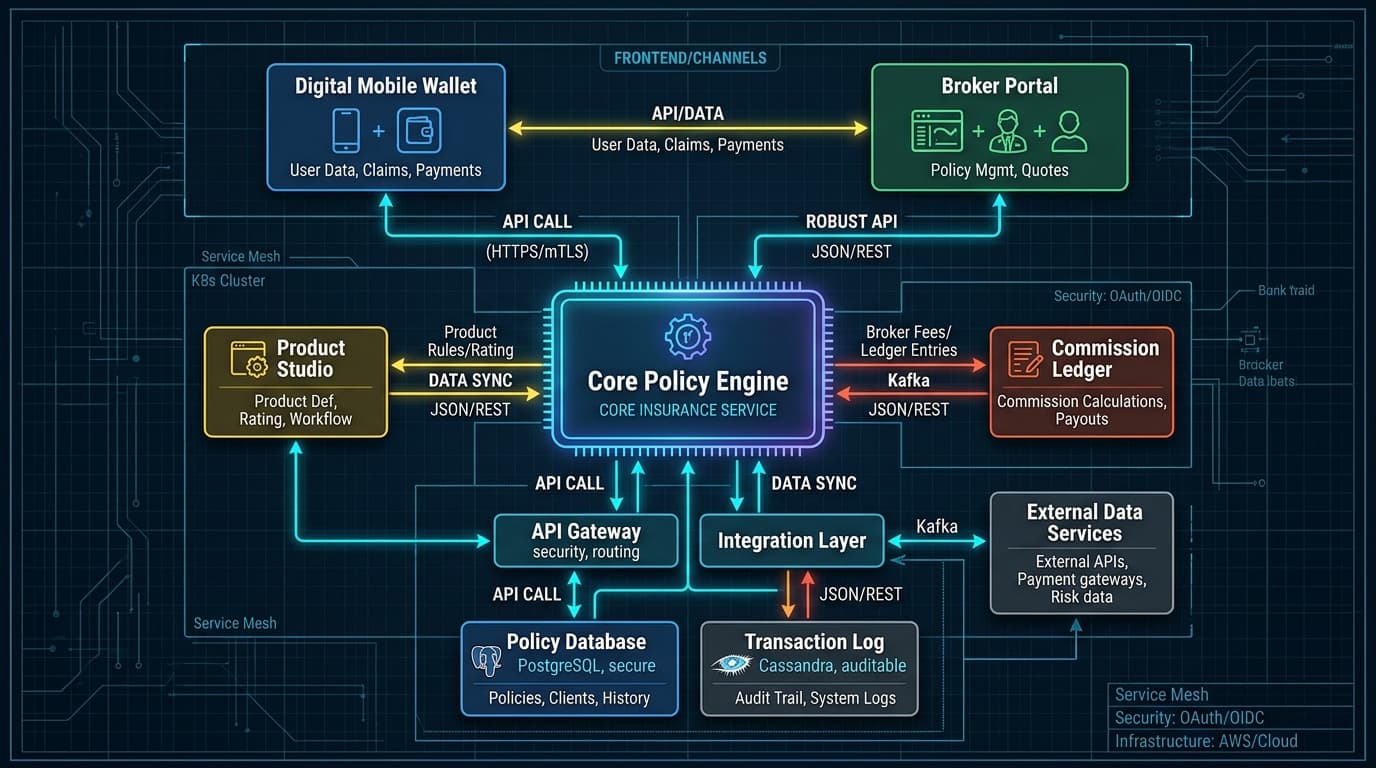
So how does a modern system like LifeBridge actually structure itself? Rather than building one giant monolithic monster or 50 microservices that turn into distributed transaction hell, the platform divides into 5 domain-modular workspaces:
- 01The Design Studio (TypeScript / Next.js 15 / ReactFlow): Where actuaries drag-and-drop insurance journeys, question flows, and living benefit riders on a visual canvas.
- 02The Distribution & Sales Portals (consumer-monorepo): Next.js apps (LifeAdvisor & LifeConsumer) and NestJS Transaction Services that parse ACORD 103 XML and stop NIGO paperwork rejections before they hit the core.
- 03The Core Engine Room (lifeflow PAS): 14 modular Spring Boot Java 25 modules managing core policy lifecycle, Drools rating, claims, billing, and annual batch crediting with physical database-per-tenant isolation.
- 04The Compensation Engine (accriva): A dedicated double-entry financial ledger enforcing validateBalance (Debits == Credits to the penny) on every agent commission payout and generating NACHA ACH wire files.
- 05Digital Pass Delivery (wallet): A fast, lightweight Bun + Express microservice that turns active policy data into cryptographically signed Apple Wallet (.pkpass) cards on the customer's phone.
Part 4: Walking Through a Live Policy ($150,000 Annuity)
To see how these services communicate, let's trace a real customer: Sarah Jenkins (Age 61, California) buying a $150,000 FIA Shield Annuity from broker David Miller:
// 1. LifeAdvisor submits validated e-App to Transaction Services
POST /v1/servicehub/compliance/LB-89421/ingest
{
  "caseId": "LB-2026-89421",
  "documentType": "ACORD_103",
  "fieldValidations": [
    { "fieldKey": "owner_name", "extractedValue": "Sarah Jenkins", "matchStatus": "MATCH" },
    { "fieldKey": "premium_amount", "extractedValue": "150000.00", "matchStatus": "MATCH" }
  ],
  "compliancePassed": true
}

// 2. Transaction Services triggers Policy Issuance in LifeFlow Core
POST http://localhost:8080/api/v1/policies/issue
Header: X-Tenant-Id: carrier-apex-life
{
  "policyNumber": "LB-2026-89421",
  "productCode": "FIA_SHIELD_7",
  "owner": "Sarah Jenkins",
  "initialPremium": 150000.00,
  "status": "INFORCE_ACTIVE"
}

// 3. LifeFlow emits PolicyIssuedEvent -> Accriva writes Double-Entry Ledger
POST http://localhost:8084/api/v1/compensation/calculate
{
  "agreementId": "LB-2026-89421",
  "producerId": "PRD-MILLER-44",
  "commissionAmount": 9000.00, // 6.0% base
  "agencyOverride": 2250.00    // 1.5% Apex Wealth Partners
}
// Accriva executes:
// DR 5010 (Commission Expense): $9,000.00
// CR 2010 (Payable to David Miller): $9,000.00
// Invariant Check: SUM(Debits) == SUM(Credits) -> PASS

// 4. LifeFlow calls Wallet Pass Service -> Pushes Apple Wallet Card
POST http://localhost:3333/wallet/v1/passes/issue
{
  "passTypeIdentifier": "pass.io.lifebridge.insurance",
  "policyNumber": "LB-2026-89421",
  "customerName": "Sarah Jenkins",
  "accountValue": "$150,000.00"
}Engineering Lessons: What Actually Matters in High-Stakes Systems
Building and studying systems like this strips away developer dogmatism. Here are the three biggest takeaways for any software architect:
- 01Bimodal IT is not a compromise — it is good engineering: Use TypeScript, React 19, and Next.js 15 where user experience and iteration speed matter (advisor portals, visual canvases, consumer apps). Use Java 25 and Spring Boot where mathematical precision, legal contracts, and multithreaded batch processing are non-negotiable.
- 02Multi-Tenancy must match regulatory risk: In SaaS dashboards, Row-Level Security (RLS) with tenant_id is fine. But in core insurance where customer records contain medical underwriting and banking info, physical database-per-tenant isolation is the only way enterprise CISOs will let you through the door.
- 03Beware developer fashion: Rust and Go are phenomenal tools for what they were built for. But when you are dealing with 50 state regulators, 30-year contractual compound math, and bank-grade double-entry ledgers, boring, battle-tested Java remains undefeated.
Frequently Asked Questions
Why can't US insurance adopt UPI and instant Aadhaar-style KYC?
The US has no national digital identity card (SSN was never designed as an ID) and no unified federal banking regulator like RBI. Furthermore, because US states hold constitutional sovereignty over insurance, creating a unified national insurance portal would require 50 separate state legislatures to pass identical laws — a political impossibility.
Is Java slow for web applications?
Legacy Java EE (WebLogic/WebSphere) from 2005 was slow and bloated. Modern Java 25 with Spring Boot 4, HikariCP, and Virtual Threads (Project Loom) achieves sub-10ms response times and handles millions of concurrent virtual threads with minimal memory overhead.
Why not use microservices for every single insurance function?
Because insurance policy issuance requires absolute transactional integrity. If premium collection succeeds but policy binding fails, you cannot rely on eventual consistency. Modular monoliths (like LifeFlow's 14 Maven modules) allow in-memory ACID transactions while still maintaining clean modular boundaries.
Continue reading

Get updates directly in your Google Search feed
Add this publication as a preferred source to highlight articles in Top Stories and AI Overviews.