If you want to truly understand how AI applications like ChatGPT with memory, semantic search engines, and RAG systems actually work under the hood, you need to understand vector databases. Everyone is talking about building AI agents and RAG, but almost nobody takes the time to explain the actual infrastructure that makes all of this possible. Trust me, once you get this, everything you've been learning about AI is going to click into place.
TL;DR — Vector databases store embeddings — numerical representations of meaning — and retrieve them by semantic similarity. They are the infrastructure that makes RAG, semantic search, and long-term AI memory possible.
The Problem That Started It All
Let's start with a real-world scenario. Imagine you're building an AI assistant for a company. The company has thousands of internal documents HR policies, product manuals, legal contracts. Your AI assistant needs to answer employee questions using that information.
The obvious idea? Dump all these documents into a regular database and search through them. Here's why that breaks down immediately.
Traditional databases like MySQL or Postgres are designed for exact or partial text matching. They work great for queries like "Find me all documents where the word 'vacation' appears." But what happens when somebody asks: "How many days off do I get per year?"
The word 'vacation' might not even appear in that question. A traditional database has no idea those two things are related. This is the core limitation that vector databases were built to solve they're designed not for exact matching, but for meaning-based matching.
What Is a Vector, Really?
Before we talk about vector databases, we need to understand vectors. And I promise this isn't a math lecture.
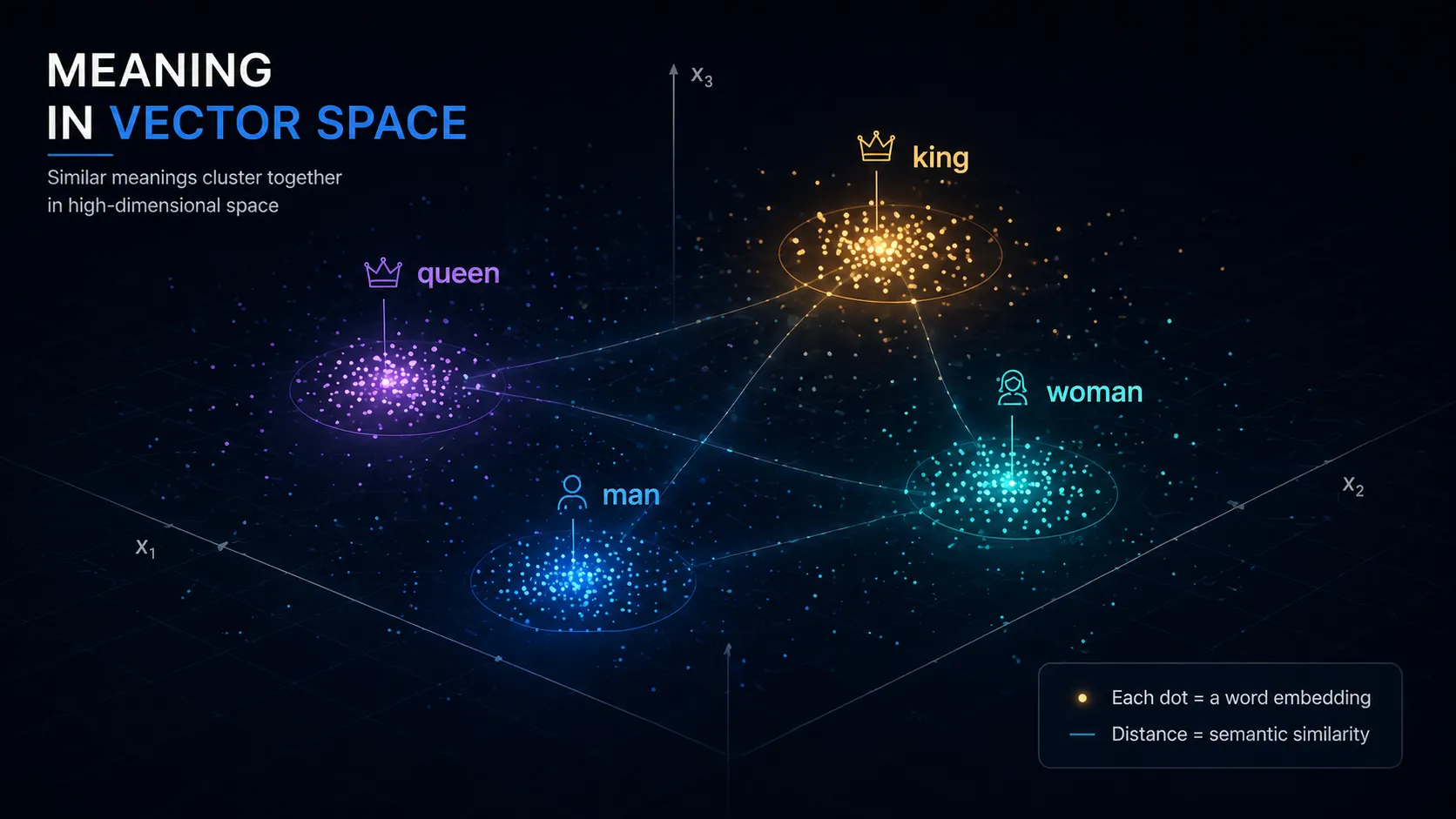
Think about how your brain understands meaning. When you hear the word 'king,' you don't just store the letters K-I-N-G. You store a whole web of associations: royalty, power, leadership, crown. Your brain has a rich, multi-dimensional understanding of what that word means in relation to everything else you know.
Machine learning models do something very similar. They convert words, sentences, images basically any kind of data into a list of numbers. That list of numbers is called a vector or an embedding.
Here's the beautiful part: these numbers aren't random. They're positioned in mathematical space in a way that actually captures meaning. Words with similar meanings end up with similar numbers, which means they end up close to each other in that vector space.
Classic example: If you take the vector for 'king,' subtract the vector for 'man,' and add the vector for 'woman,' you end up extremely close to the vector for 'queen.' The model has learned that royalty and gender are real, manipulatable dimensions of meaning.
When you convert your company's thousands of documents into vectors, you've translated all that text into a mathematical language that captures meaning, not just keywords. When a user asks a question like "How many days off do I get this year?" that question also gets converted into a vector, and the database finds the documents whose vectors are closest to it in meaning even if they don't share a single word with the original question.
RAG: Where Vector Databases Shine
The most important use case right now in AI is RAG, which stands for Retrieval Augmented Generation. Here's my favorite analogy for this:
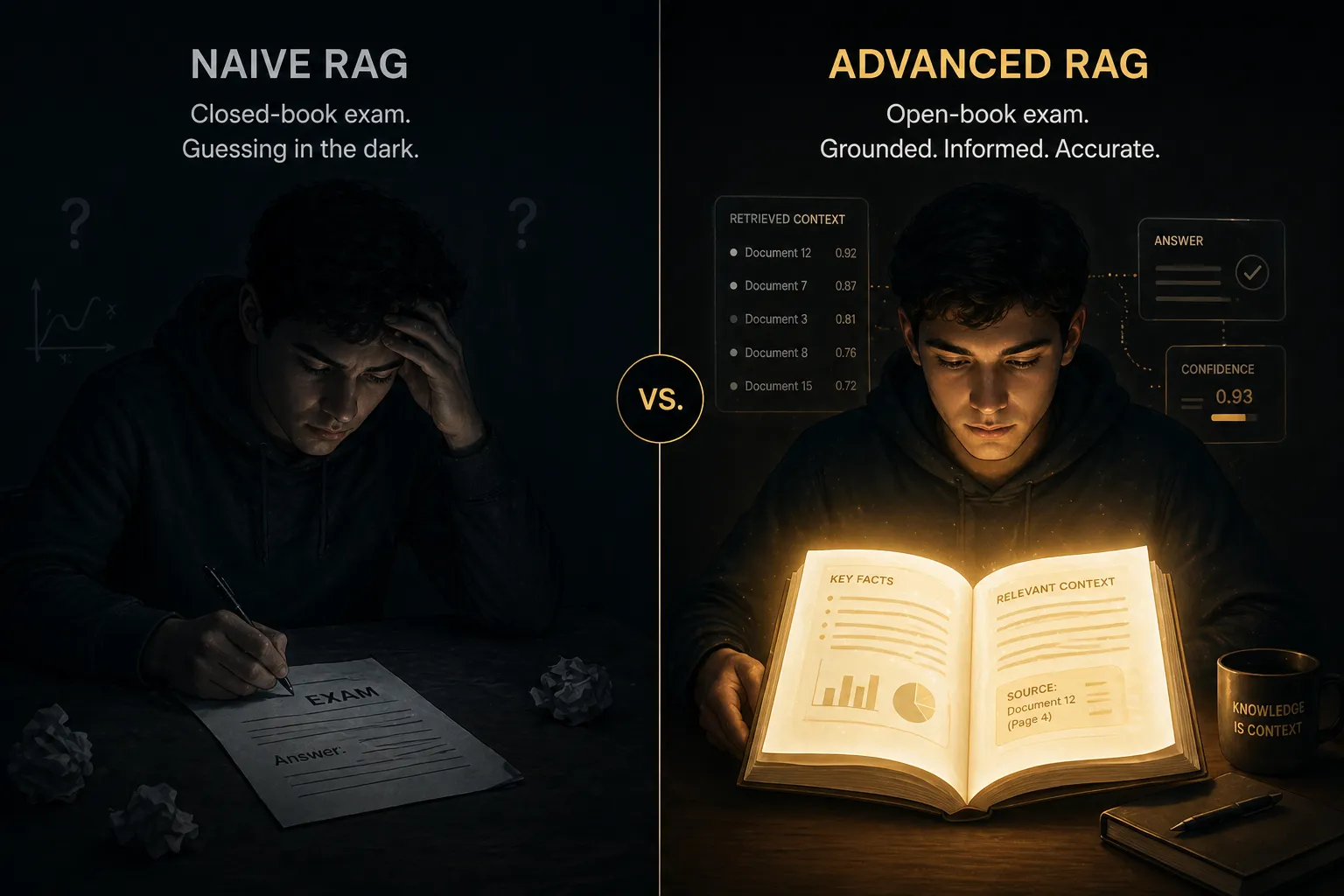
Think about a closed book exam. You can only answer questions based on what you've memorized. If you didn't study something, you're stuck. That's basically a large language model without RAG. It can only answer based on what it learned during training.
Now imagine an open book exam where you have a textbook right in front of you. You get the question, you flip to the relevant chapter, read the relevant section, and then you write your answer using both your reasoning ability and the actual information from that book. That is RAG.
The LLM is the student with great reasoning ability, and the vector database is the textbook.
How RAG Works in Practice
- 01Take all your documents and convert them into vectors using an embedding model
- 02Store those vectors in a vector database
- 03When a user submits a query, convert that query into a vector
- 04Search the database for the most semantically similar documents
- 05Retrieve the top results
- 06Pass those results along with the original query to the LLM
- 07The LLM generates a grounded and accurate response instead of guessing
This is why RAG is such a big deal. It solves the hallucination problem for domain-specific knowledge, and vector databases are the heart of the retrieval step.
Chunking Strategy Matters
Here's a mistake I see constantly: how you chunk your documents before converting them into embeddings is just as important as the database you choose.
- If your chunks are too large, you lose precision
- If they're too small, you lose context
- A solid starting point is 300-500 tokens per chunk
- Use 50-100 tokens of overlap at the boundaries
- Use a semantic chunker if your framework supports it, not just a fixed-size character splitter
The difference in retrieval quality is real and noticeable.
Which Vector Database Should You Use?
There are a lot of options out there, so let me be direct about where you should start:
Getting Started Locally: ChromaDB
If you're just experimenting locally, go with ChromaDB. It's incredibly easy to set up and works great with LangChain and LlamaIndex. You can have a working RAG prototype on your laptop in under an hour. That's your entry point.
Performance + Self-Hosting: Qdrant
If you want performance and want to self-host, look at Qdrant. It's open-source, written in Rust (so it's extremely fast and memory efficient), and their documentation is amazing. You can run it locally with Docker in 5 minutes.
Production-Ready Managed: Pinecone
If you're building a production application and don't want to manage infrastructure, Pinecone is the most popular fully managed option right now. It scales automatically, integrates well with most AI frameworks, and the free tier is generous enough to prototype before you commit.
Hybrid Search: Weaviate
Then there's Weaviate, which is worth knowing about because it supports hybrid search meaning you can combine vector similarity search with traditional keyword search in the same query. That's powerful for production use cases where you want the best of both approaches.
Beyond RAG: Other Cool Use Cases
Vector databases aren't just for RAG. Here are some other fascinating applications:
- Spotify uses vector similarity to recommend songs you've never heard but you'll probably love because your listening history gets converted into a vector and matched against a catalog of song vectors
- Netflix does the same for content recommendation
- Pinterest lets you take a picture of a room you love and find visually similar pins because that image gets converted into a vector by a vision model
- Anomaly detection in cybersecurity works the same way normal network traffic clusters together in vector space, and behavior that's far away from that cluster triggers an alert
The mental model is always the same: convert your data into a rich numerical representation, store it in a way that makes similarity search fast, and use that for matching, recommendation, or retrieval.
Final Thoughts
Once you internalize how vector databases work, you'll start seeing use cases everywhere. The key insight is this: traditional databases match exact values, but vector databases match meaning. And in the age of AI, meaning is everything.
If you're just starting out, grab ChromaDB and build a simple RAG system. Convert some documents, ask some questions, and watch the magic happen. Once you understand the fundamentals, you can scale up to production-grade solutions like Qdrant or Pinecone.
The AI revolution isn't just about large language models it's about the infrastructure that makes them useful in the real world. And vector databases are at the heart of that infrastructure.
Need an AI engineer for your project? I build RAG systems, LLM integrations, AI agents, and SaaS backends. Reach me at prayagbagthariya.vercel.app/hire-me or prayag129787@gmail.com.
Frequently Asked Questions
What is a vector database and how is it different from a traditional database?
A traditional database stores structured data and finds records by exact matches or range queries. A vector database stores high-dimensional numerical representations (embeddings) of data and finds records by semantic similarity. Instead of 'find rows where name = vacation policy', you ask 'find documents that mean the same thing as how many days off do I get' — and get relevant results even with no word overlap.
What are embeddings and how do they capture meaning?
Embeddings are numerical vectors produced by machine learning models that encode the semantic meaning of content. Similar concepts get mapped to nearby points in vector space — so 'automobile' and 'car' end up close together. Embedding models like OpenAI's text-embedding-ada-002 or open-source alternatives like sentence-transformers learn these mappings from billions of text examples.
What is the best vector database for a developer just getting started?
ChromaDB is the best starting point — it runs locally with no infrastructure setup, has a simple Python API, and is free. Once you need production features, Qdrant offers excellent open-source self-hosting. Pinecone is the fully-managed option that requires no infrastructure management but has usage-based costs. Start local with ChromaDB and migrate when you have real scale requirements.
What is approximate nearest neighbor (ANN) search and why do vector databases use it?
Exact nearest neighbor search compares a query vector against every stored vector — accurate but prohibitively slow at scale. Approximate nearest neighbor algorithms like HNSW trade a small amount of accuracy for massive speed gains, enabling millisecond searches across millions or billions of vectors. For most production applications, the accuracy tradeoff is negligible and the speed improvement is essential.
Can I add vector search to my existing database without a separate vector database?
Yes. PostgreSQL with the pgvector extension, Redis with RediSearch, and MongoDB with Atlas Vector Search all support vector similarity search alongside traditional queries. This is often the right starting point — you get vector search without adding infrastructure complexity. A dedicated vector database becomes worth it at very large scale (hundreds of millions of vectors) or when you need advanced indexing and filtering performance.
Continue reading
Get updates directly in your Google Search feed
Add this publication as a preferred source to highlight articles in Top Stories and AI Overviews.