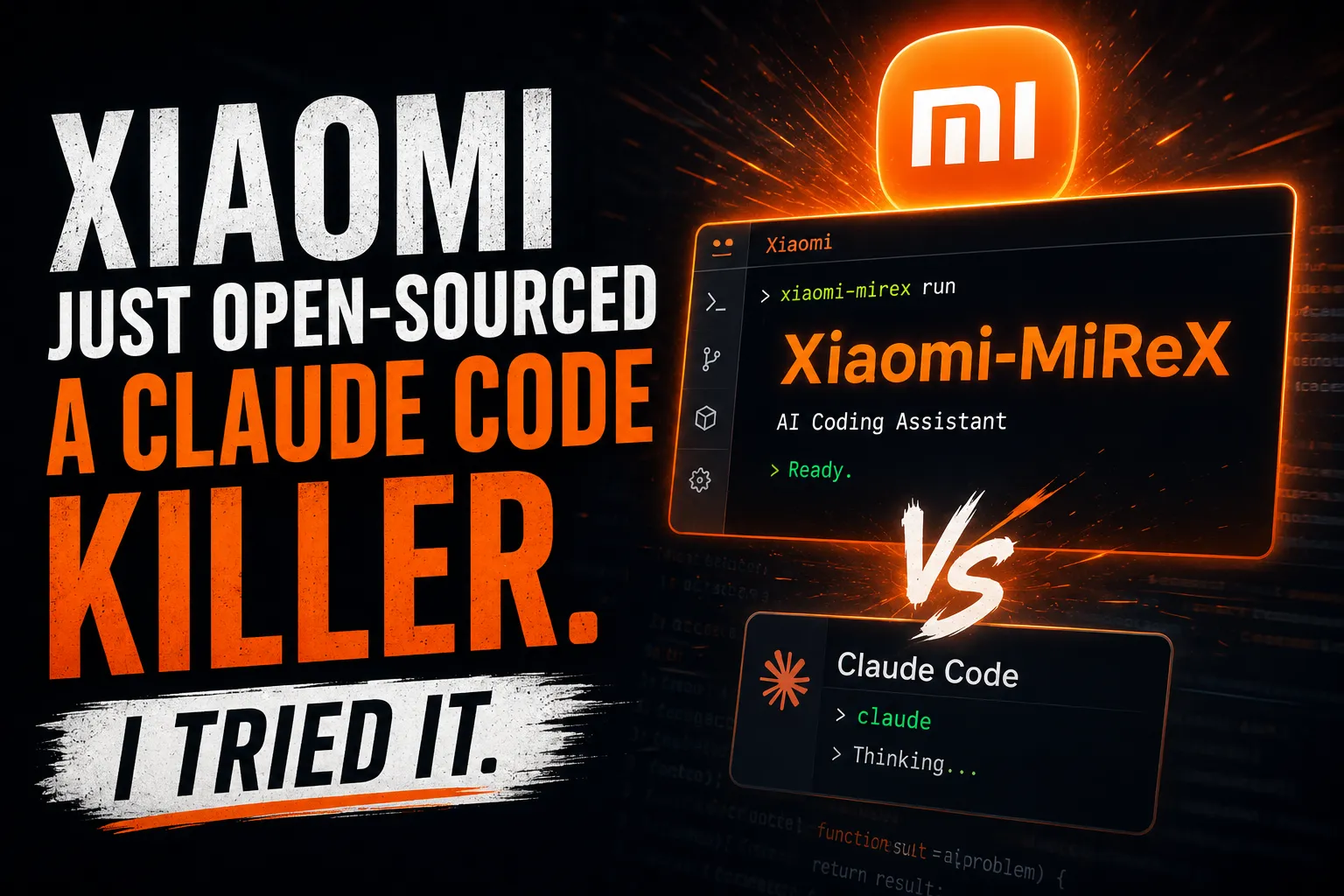
On June 10, Xiaomi shipped MiMo Code V0.1.0 — a terminal-native agentic coding assistant, MIT-licensed, open source on GitHub, and free to use with their own model right now. It scored 62% on SWE-Bench Pro and 73% on Terminal-Bench 2, beating Claude Code by roughly five percentage points on both. I set it up the same day and ran it on an actual project. Here's what the benchmarks don't tell you.
TL;DR — Mimo Code is a self-hostable, open-source alternative to Claude Code. If you need agentic coding without vendor lock-in or API cost per-seat, Mimo Code is the most production-ready option available today.
MiMo Code is not just another AI autocomplete wrapper. It's a full agentic harness — it intercepts terminal output, reads directory state, runs bash commands, and deploys a separate subagent just to take notes so the main agent never loses focus. That architecture is genuinely new.
What MiMo Code Actually Is
MiMo Code runs entirely in your terminal. No IDE required, no browser tab, no subscription wall. You install it with one command, point it at a project, and it takes over. What makes it different from running Claude Code in the terminal is the architecture underneath.
The model it ships with — MiMo-V2.5 — is described as comparable to Claude Sonnet 4.6 in capability. It also supports swapping in DeepSeek, Kimi, and GLM as the backend if you prefer. The free tier is time-limited but currently available, which means right now you can run a Sonnet-class coding agent with no API bill.
The Four-Layer Memory System Is the Real Story
Every other AI coding agent I've used has the same problem: start a new session and it forgets everything. You spend the first five minutes re-explaining the project structure, your conventions, what you tried yesterday. MiMo Code approaches this differently with a four-layer persistent memory system:
- MEMORY.md — a persistent project-level file updated after every session with high-level context about the codebase, decisions made, and things to avoid
- Session checkpoints — snapshots of what the agent was doing when a session ended, so it can resume rather than restart
- Scratch notes — a working buffer the agent uses mid-task, like a developer's draft pad
- Per-task progress logs — granular records of what was attempted, what worked, and what was abandoned for each task
All of this is powered by SQLite FTS5 full-text search under the hood, so the agent can query its own memory rather than scanning everything linearly. The clever part: instead of making the main coding agent pause to take notes (which breaks its reasoning chain), MiMo deploys a separate checkpoint-writer subagent that runs alongside it. The main agent never has to context-switch.
Why It Beats Claude Code on Long Tasks
The SWE-Bench numbers (62% vs ~57% for Claude Code) matter less than the Terminal-Bench 2 result. Terminal-Bench 2 tests 200+ step agentic workflows — the kind of task where you ask an agent to research a bug, implement a fix across multiple files, write tests, run them, iterate on failures, and clean up. This is where context window limits and lack of persistent memory kill most agents. MiMo's architecture is specifically designed for exactly this class of problem.
In practice: I gave it a task that involved modifying a NestJS service, updating three related tests, and checking that no imports broke. Claude Code on a fresh session needed me to describe the structure first. MiMo read MEMORY.md, knew the project layout from the previous session, and started working immediately. That's the real-world version of the benchmark advantage.
Setup in 5 Minutes
macOS / Linux
# Install
curl -fsSL https://mimo.mi.com/install.sh | bash

# Or via npm (also works on Windows)
npm install -g @xiaomi/mimo-code

# Start in your project directory
cd your-project
mimo
Switch to a Different Model (Optional)
# Use DeepSeek instead of MiMo-V2.5
mimo config set model deepseek-v3
mimo config set api-key YOUR_DEEPSEEK_KEY

# Or use any OpenAI-compatible endpoint
mimo config set model gpt-4o
mimo config set base-url https://api.openai.com/v1
mimo config set api-key YOUR_OPENAI_KEY
Compose Mode — Your Most Useful Key
Press Tab inside MiMo to enter Compose mode. This is where it goes from 'coding assistant' to 'autonomous developer.' You give it a brief idea — 'add pagination to the users endpoint' — and it handles design, planning, implementation, testing, and review as a complete pipeline without you steering each step. In Plan mode (Shift+Tab), it shows you the execution plan before running anything, which is what I use for anything touching production code.
MiMo Code vs Claude Code — Honest Comparison
I've been using Claude Code daily for months. Here's where MiMo actually wins and where it doesn't:
MiMo wins at:
- Long multi-session tasks — the persistent memory is a genuine competitive advantage, not a marketing bullet point
- Cost — free right now with MiMo-V2.5, and MIT-licensed so you can self-host and bring your own model
- Terminal-native workflows — if you live in the terminal, it feels more native than Claude Code's hybrid approach
- 200+ step autonomous runs — its architecture was explicitly designed for this, Claude Code's wasn't
Claude Code still wins at:
- Model quality ceiling — Fable 5 is available via Claude Code; MiMo-V2.5 is Claude Sonnet 4.6 class, not Fable 5 class
- IDE integration — Claude Code's VS Code extension and web IDE are more polished than anything MiMo ships
- Ecosystem maturity — MCP server support, hooks, CLAUDE.md project config are all more battle-tested
- Trust — Anthropic's safety track record is longer; Xiaomi is a hardware company that launched an AI lab
The honest answer: use MiMo Code for long autonomous tasks where you want to fire-and-forget overnight. Use Claude Code for the high-stakes, precision work where model quality at the ceiling matters more than memory persistence.
The Bigger Picture: SoloEngine
MiMo Code is actually a Trojan horse. Xiaomi's real play is MiMo SoloEngine — a low-code agentic AI development platform that wraps MiMo Code's capabilities into a visual canvas. You drag agents onto a board, connect their relationships, configure tools, and click Run. The backend compiles it into a working agentic system with ReAct loops, tool calling, MCP support, and subagent orchestration — all without writing framework code.
The ambition is explicit: Xiaomi wants to be what Anthropic is to developers, but for every other industry. A logistics company runs a warehouse scheduling agent. A hospital runs a patient intake agent. A factory runs a supply chain agent. MiMo Code is the proof-of-concept. SoloEngine is the product they actually want to sell. Open-sourcing MiMo Code is how they get developers to trust the platform.
Should You Switch?
No. But you should add it. MiMo Code costs nothing right now and installs in two minutes. The persistent memory alone is worth having even if you keep Claude Code as your primary. Set MiMo up, give it your project context once, and let it run your long refactoring tasks overnight. Come back to Claude Code for the precise, high-stakes work.
The more interesting question isn't MiMo vs Claude Code. It's what happens when every major tech company ships a free, open-source coding agent. Google has one. Meta has one now. Xiaomi just joined. The pressure this puts on $20/month pricing for AI coding tools is real, and developers who understand how these agents actually work under the hood will be the ones who know which tool to reach for and when.
Need an AI engineer for your project? I build RAG systems, LLM integrations, AI agents, and SaaS backends. Reach me at prayagbagthariya.vercel.app/hire-me or prayag129787@gmail.com.
Frequently Asked Questions
What is MiMo Code?
MiMo Code is an open-source, MIT-licensed terminal coding agent released by Xiaomi on June 10, 2026. It runs autonomously in your terminal, supports 200+ step agentic workflows, has a four-layer persistent memory system across sessions, and is currently free to use with Xiaomi's own MiMo-V2.5 model.
Is MiMo Code actually better than Claude Code?
On specific benchmarks — SWE-Bench Pro (62% vs ~57%) and Terminal-Bench 2 (73%) — MiMo Code outperforms Claude Code, particularly on long multi-step tasks. However, Claude Code has a higher model ceiling (Claude Fable 5), more mature IDE integration, and a stronger ecosystem. They're better used together than as direct replacements.
How does MiMo Code's memory system work?
MiMo Code uses a four-layer memory system: a persistent MEMORY.md project file, session checkpoints, scratch notes, and per-task progress logs — all backed by SQLite FTS5 full-text search. A separate checkpoint-writer subagent handles note-taking so the main coding agent never has to interrupt its reasoning chain.
Is MiMo Code free to use?
Yes — currently MiMo Code is free to use with Xiaomi's MiMo-V2.5 model (comparable to Claude Sonnet 4.6 in capability). This free tier is time-limited. You can also bring your own model — it supports DeepSeek, Kimi, GLM, and any OpenAI-compatible API endpoint.
What is MiMo SoloEngine?
MiMo SoloEngine is Xiaomi's low-code agentic AI platform — a visual canvas where you drag agents, connect them, configure tools, and generate working agentic AI systems without writing orchestration code. It handles ReAct loops, tool calling, MCP support, and subagent management in the backend. MiMo Code is the developer-facing proof-of-concept; SoloEngine is Xiaomi's commercial play for non-developer industries.
Continue reading

Get updates directly in your Google Search feed
Add this publication as a preferred source to highlight articles in Top Stories and AI Overviews.