
There's a humbling moment every developer eventually faces you ship your app, it works perfectly on your machine, and then the moment real traffic hits, everything falls apart. I've been going deep into system design lately, and honestly? It completely changed how I think about building software. This isn't about clever algorithms or clean code. It's about architecture the decisions that determine whether your app survives 10 users or 10 million.
TL;DR — Apps that survive 10M users are built on decisions made early: stateless services, read replicas, async queues, and CDN-first asset delivery. Each architectural choice either compounds or kills you at scale.
What Does "Production-Level" Even Mean?
Building something for yourself is easy. Building something that works for millions of people simultaneously, without going down, without losing data, and without slowing to a crawl that's system design.
Production-level design is essentially the art of anticipating failure and building around it before it happens. Every decision you make where you store data, how servers talk to each other, how you handle traffic spikes has real consequences at scale.
1. Vertical vs. Horizontal Scaling: Choosing How You Grow
The first problem you'll hit when traffic grows is simple: your server can't keep up. You have two ways to solve it.
Vertical Scaling (Up)
Vertical scaling means buying a bigger, more powerful machine more CPU, more RAM. It's straightforward and requires zero changes to your code. But it has a hard ceiling. There's only so big a single server can get, and more critically, it creates a single point of failure. One machine breaks, the whole app goes down.
Horizontal Scaling (Out)
Horizontal scaling means adding more servers instead of bigger ones. This is how Google, Meta, and Amazon operate. There's theoretically no upper limit, and if one server dies, the others keep running. The tradeoff? Your architecture gets more complex but that complexity is worth it.
2. Load Balancers: The Traffic Cop Your App Needs
Once you have multiple servers, you immediately hit a new problem: how do incoming users know which server to connect to? That's where a load balancer comes in. It sits in front of your server fleet, receives all incoming requests, and distributes them across servers based on which ones are least busy.
For this to work properly, your servers need to be stateless. If Server A stores a user's session data locally, and their next request goes to Server B, things break. Stateless servers don't hold onto user data themselves they read from a shared source of truth. Every server can handle any request, which makes the whole system far more resilient.
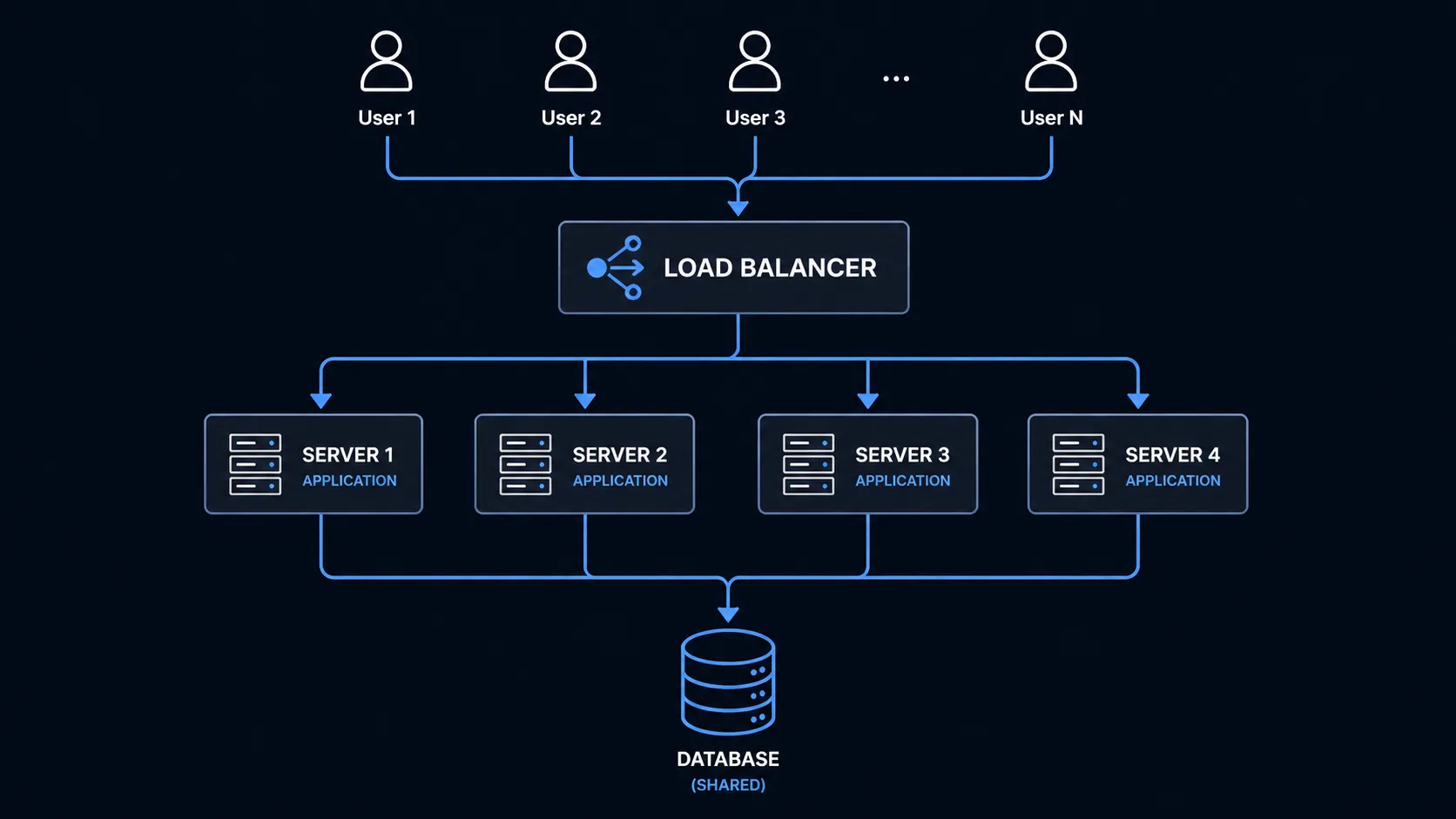
3. Caching and Message Queues: The Two Speed Tricks Nobody Talks About Enough
Caching (Redis, Memcached)
Imagine a celebrity with 50 million followers posts something. Every single one of those followers might refresh their feed in the next few minutes. Should your database run the same query 50 million times? Absolutely not.
Caching stores the result of expensive or frequently-requested data in fast in-memory storage. When someone requests that celebrity's profile, you check the cache first. If it's there, you serve it instantly without touching the database at all. A TTL (Time to Live) ensures the cache automatically refreshes after a set period so users aren't seeing stale data.
Message Queues (Kafka, RabbitMQ)
Imagine a million people hit "like" in the same 10-second window. Your database can't write a million records simultaneously it'll buckle. Message queues solve this by acting as a buffer. Each event gets added to a queue, and the database processes them in order at whatever rate it can handle. Users still see immediate feedback in the UI, but the actual database writes happen asynchronously.
This pattern accepting work fast but processing it steadily is called backpressure handling, and it's critical for any feature involving bursts of activity: notifications, emails, analytics events.
4. Sharding: When Even One Database Isn't Enough
You've scaled your servers horizontally. You've added caching. But eventually, the database itself becomes the bottleneck because you only have one of it.
Sharding splits your data across multiple database instances. Each shard handles a fraction of the total data, so no single machine gets overwhelmed. For example:
- Users with IDs 1–1,000,000 live on Database A
- Users with IDs 1,000,001–2,000,000 live on Database B
- Each shard handles a fraction of the total load
It's powerful, but it adds complexity. You need a routing layer that knows which shard holds what. Cross-shard queries become expensive and tricky. Sharding is a tool you reach for when you genuinely need it not something to implement prematurely.
5. The CAP Theorem: The Uncomfortable Trade-Off at the Core of Distributed Systems
In any distributed system, you're trying to achieve three properties simultaneously but you can only guarantee two at a time:
- Consistency every user sees the same, up-to-date data at the same time
- Availability the system is always up and responsive
- Partition Tolerance the system keeps working even if parts of the network fail
In practice, partition tolerance is non-negotiable networks fail. So the real choice is between consistency and availability:
- CP systems (Consistent + Partition Tolerant): Return an error rather than stale data. Banking systems work this way.
- AP systems (Available + Partition Tolerant): Keep serving responses even if data is slightly stale. Social media feeds work this way.
Putting It All Together
A simplified production-grade architecture:
- 01Users hit a load balancer, which routes them to one of many stateless application servers
- 02Those servers check a Redis cache before querying the database
- 03High-volume write events go into a Kafka message queue for async processing
- 04The underlying data is sharded across multiple database nodes
- 05Every decision is made with CAP trade-offs consciously in mind
Final Thoughts
What surprised me most about system design is how much of it is about failure. Every pattern here horizontal scaling, load balancers, queues, sharding exists because something will eventually go wrong. The goal isn't to prevent failure entirely. It's to make sure failure in one place doesn't take everything else down with it.
Start with the scaling fundamentals and load balancing concepts. Once those click, caching and message queues will feel intuitive. CAP theorem is the one you'll keep coming back to as your systems grow more complex.
Need an AI engineer for your project? I build RAG systems, LLM integrations, AI agents, and SaaS backends. Reach me at prayagbagthariya.vercel.app/hire-me or prayag129787@gmail.com.
Frequently Asked Questions
What is system design and why should every developer learn it?
System design is the process of defining the architecture, components, and data flows of a software system to meet scalability, reliability, and latency requirements. Every developer should learn it because the decisions made at the architecture level determine whether an application can serve 100 users or 100 million — and these decisions are exponentially harder to change once the system is in production.
When should I start thinking about horizontal scaling for my application?
Start thinking about it when a single server's resources become the limiting factor under real load — typically when your server regularly runs above 70% CPU or memory utilization, or when a single process restart would take down the entire application. Designing for stateless request handling from the start makes horizontal scaling dramatically easier when the time comes.
What is the CAP theorem in simple terms?
CAP theorem states that a distributed system can only guarantee two of three properties: Consistency (all nodes see the same data at the same time), Availability (every request gets a response), and Partition Tolerance (the system keeps working even if network links between nodes fail). Since network partitions are unavoidable in distributed systems, you're always choosing between consistency and availability during a partition — PostgreSQL chooses consistency, Cassandra chooses availability.
What is a load balancer and when do I actually need one?
A load balancer distributes incoming traffic across multiple server instances, preventing any single instance from being overwhelmed. You need one as soon as you run more than one instance of your application. Beyond distribution, load balancers provide health checks (automatically routing around failed instances), SSL termination, and connection management. Cloud providers like AWS ALB, Google Cloud, and Vercel handle load balancing automatically for most modern deployment patterns.
What is database sharding and when is it necessary?
Sharding splits a database horizontally across multiple servers, with each server holding a subset of the rows. It's necessary when a single database server can no longer handle your read/write throughput or storage requirements — typically at hundreds of millions of rows or thousands of writes per second. Before sharding, exhaust simpler options: read replicas for read scaling, connection pooling, caching for frequently-read data, and query optimization.
Continue reading

Why "Vibe Coding" Feels Like Flying Until You Hit Production: A Brutally Honest Field Guide for 2026

Why Insurtech Still Runs on Java: What Building US Retirement Engines Taught Me About Architecture, Rust, and Why India Got It Right
Get updates directly in your Google Search feed
Add this publication as a preferred source to highlight articles in Top Stories and AI Overviews.