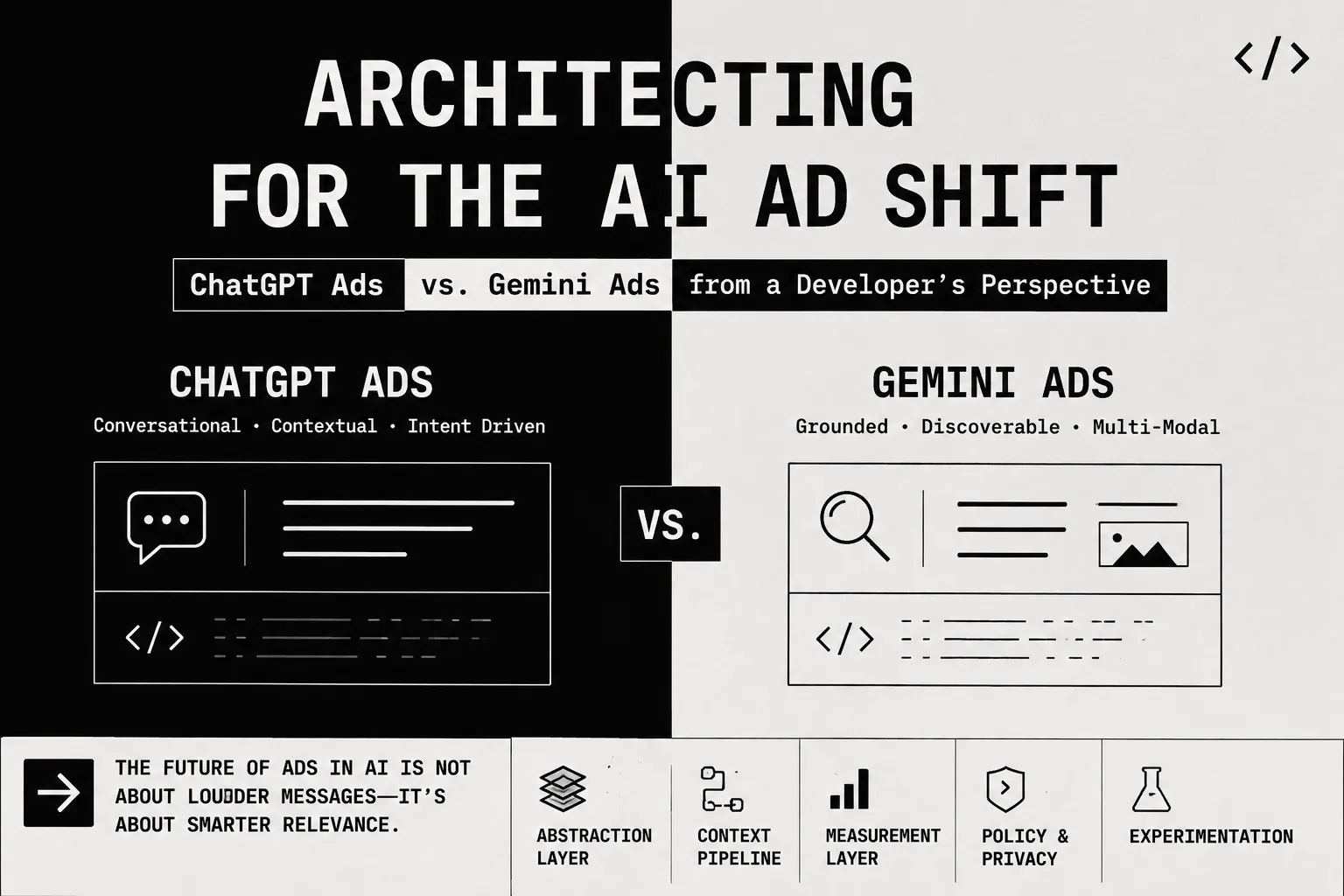
The digital advertising landscape just experienced its most profound architectural pivot since the launch of Google AdWords. With OpenAI rolling out conversational ads in ChatGPT and Google deeply embedding monetization into Gemini AI Overviews, the industry is moving away from deterministic keyword auctions. For developers, engineers, and data scientists, this isn't just a change in user interface — it's a fundamental rewrite of the backend data structures, ingestion pipelines, and retrieval mechanics that power the web's primary monetization engine.
TL;DR — Conversational AI ads replace keyword auctions with intent-driven retrieval. For developers this means new vector-based ad matching pipelines, attribution models that track multi-turn conversations, and semantic budget allocation.
1. The Core Engineering Philosophy: Contextual Graph vs. Relational Intent
The most significant divergence between these two platforms lies in their semantic matching engines. Traditional search used deterministic keyword strings to trigger an ad auction. Gemini AI Ads layer a transformer model on top of decades of identity graph data — Chrome history, Maps usage, Android signals, Gmail context. ChatGPT Ads take a completely different approach: they parse the entire multi-turn conversation as a live session vector, building a semantic trajectory in real time.
[Traditional Search] ---> Keyword Match (Deterministic Strings) ---> Ad Auction
[Gemini AI Ads]      ---> Vectorized Intent + Decades of Identity Graph ---> Ad Auction
[ChatGPT Ads]        ---> Multi-turn Session Vector + Semantic Trajectory ---> Ad Graph
OpenAI: Semantic Session Trajectory
Because OpenAI lacks a legacy database of user search histories, its system relies heavily on in-session contextual vectors. Instead of firing an auction based on a static string, ChatGPT's ad infrastructure parses the entire multi-turn conversation thread. It evaluates the semantic trajectory — the user's initial prompt, intermediate constraints, and localized context (e.g., "I have $3,000 for desert landscaping tools in Phoenix").
- Engineers working with OpenAI's ad API can't just pass keyword lists like ["landscaping tools", "lawn mower"] — they must design application data to map to dynamic intent categories and persona vectors.
- The system matches the ad to the conversation's real-time embedding space.
- Ads render as isolated "tinted boxes" so the core LLM output remains unbiased — a principle OpenAI calls Answer Independence.
Google Gemini: The Ultimate Identity Graph
Google isn't reinventing the wheel — they are strapping an LLM engine to the world's largest relational database. Gemini Ads (delivered via AI Overviews and Performance Max) process the query through a transformer model to understand nuance, but the underlying ad selection is heavily weighted by Google's massive cross-platform identity graph spanning Chrome, Maps, Android, and Gmail.
- The engineering challenge on Google's side is data feed optimization and schema compliance — your structured data is what Google's systems parse to decide if your product fits a dynamically generated AI summary.
- Performance Max ingests broad asset groups (images, copy, structured feeds) and uses predictive models to select which combination fits the AI Overview context.
- Developers must ensure their web application's JSON-LD schemas, semantic HTML, and structured data feeds are fully compliant for LLM crawlers.
2. Technical Breakdown: How They Compare
Here's how the two platforms map to the key architectural decisions that matter for engineers and marketing technology teams:
- Ingestion Input — ChatGPT Ads: real-time session embedding from multi-turn prompts. Gemini Ads: single-turn query expansion combined with historical user identity signals.
- Ad Placements — ChatGPT Ads: isolated UI elements ("tinted boxes") separated from the LLM answer. Gemini Ads: integrated inline within AI Overviews and the Performance Max network.
- Targeting Paradigm — ChatGPT Ads: contextual conversation vectors and persona-based intent matching. Gemini Ads: in-market segments, custom intent audiences, and remarketing lists.
- Developer API Surface — ChatGPT Ads: emerging, persona and intent-driven endpoint configuration. Gemini Ads: established Google Ads API with mutations and Performance Max asset group management.
- Data Advantage — ChatGPT Ads: pure semantic understanding of real-time context with no prior user history. Gemini Ads: decades of behavioral, geographic, and cross-platform identity data.
3. The Measurement Crisis: Attributing the Invisible
For backend and data engineers, the shift to AI search advertising introduces a massive telemetry problem. In traditional search, tracking was simple: a user clicked an ad, a tracking template appended a gclid (Google Click ID) or UTM parameters, and the browser fired a pixel on the landing page. In a conversational AI interface, attribution becomes non-linear.
User Prompt -> AI Answer -> Follow-up Question -> Ad Visual -> User Continues Chatting -> Later Purchase- The Clickless Impression: An AI assistant may synthesize information from your ad or site directly into the chat flow. If a user gets their answer without ever clicking to your website, how do you measure ROI?
- Session Persistence vs. Privacy: OpenAI's architecture prioritizes sandboxed user sessions. Passing deterministic tracking tokens across long, multi-turn conversations without violating user privacy presents a complex cryptographic and state-management challenge.
- The Dead End: Relying on client-side JavaScript pixels to track a linear user journey is an architectural dead-end in the AI era.
As developers, we must pivot toward Server-to-Server (S2S) Conversions APIs and first-party data capture. Client-side pixel tracking assumes a linear click path that no longer exists in conversational AI interfaces.
4. Key Developer Takeaways for 2026
If you are building applications that interface with digital marketing stacks or designing internal e-commerce data pipelines, keep these architectural realities in mind:
- Optimize for RAG (Retrieval-Augmented Generation): Since Gemini pulls directly from indexed web content to form AI Overviews, ensure your web application's semantic HTML, structured JSON-LD schemas, and API endpoints are optimized for LLM crawlers. Your content is the ad creative.
- Shift to Entity-Based Data Architecture: Stop building data structures centered strictly around keywords. Start mapping your products and services to semantic entities and relations (problem-solved, geographic constraints, budget tiers) so they align with OpenAI's contextual persona matching.
- Prepare for Dual-Engine Infrastructure: The immediate future requires a hybrid approach. Build your internal marketing tech pipelines to support Google's massive, identity-driven automation (PMax) while also building hooks to feed OpenAI's real-time, context-heavy conversational placements.
- Adopt First-Party Data Pipelines Now: With attribution becoming non-linear, your server-side event tracking, CRM integrations, and Conversions API setups are no longer optional — they are the foundation of measurable ROI in the AI ad era.
Are you currently engineering systems to optimize for LLM crawlers, or are you focusing on first-party data pipelines to combat the attribution shift? The two paths aren't mutually exclusive — in 2026, you'll need both.
Need an AI engineer for your project? I build RAG systems, LLM integrations, AI agents, and SaaS backends. Reach me at prayagbagthariya.vercel.app/hire-me or prayag129787@gmail.com.
Frequently Asked Questions
What is the core technical difference between ChatGPT Ads and Gemini Ads?
ChatGPT Ads use a real-time conversational session vector — the entire multi-turn conversation is parsed as a semantic trajectory that evolves with each message. Gemini Ads layer a transformer model on top of Google's identity graph (Chrome history, Maps, Android signals, Gmail). ChatGPT matches on contextual intent in the moment; Gemini matches on historical behavioral identity patterns.
How does the shift to AI ads affect SEO and content strategy for developers?
AI Overviews and conversational ad placement mean your content needs to be optimized for LLM retrieval, not just keyword indexing. This means semantic HTML structure, JSON-LD schema markup, clear entity relationships in your content, and factual accuracy. The shift favors content that answers specific questions comprehensively over content optimized for keyword density.
What is a Conversions API and why is it critical now?
A Conversions API (CAPI) sends conversion event data directly from your server to the advertising platform, bypassing browser-based pixel tracking that is increasingly blocked by ad blockers, iOS privacy changes, and browser restrictions. As AI ad systems rely on conversion data to optimize targeting, server-side event tracking through CAPI maintains the signal quality that browser pixels are losing.
How should backend engineers prepare their systems for AI ad infrastructure?
Three priorities: implement server-side event tracking (Conversions API for Meta and Google) to maintain attribution signal quality; optimize content endpoints for LLM crawlers with semantic HTML and structured data (JSON-LD); and build first-party data pipelines that capture behavioral signals you own — email engagement, on-site behavior, purchase history — to feed into AI ad platforms' audience targeting systems.
What is the difference between PMax campaigns and ChatGPT's conversational ad placement?
Google's Performance Max (PMax) uses Google's identity graph and behavioral history to place ads across all Google surfaces, optimized by AI using accumulated conversion history. ChatGPT's conversational placement is session-scoped — ads are matched to the live conversation context rather than historical profile data. PMax optimizes over time; ChatGPT placement starts fresh with each conversation based on real-time semantic signals.
Continue reading

Get updates directly in your Google Search feed
Add this publication as a preferred source to highlight articles in Top Stories and AI Overviews.