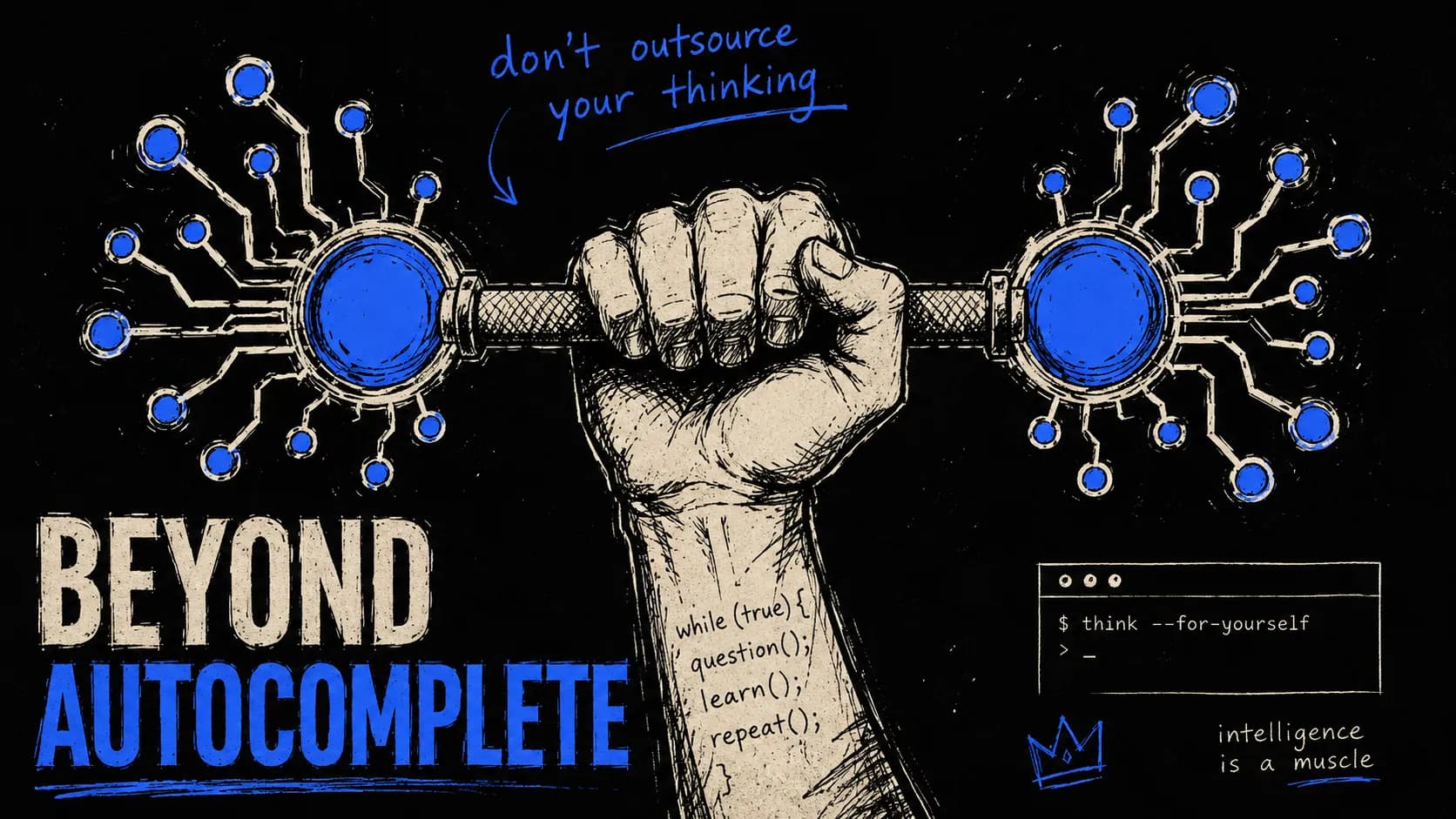
In the world of software development, it is easy to let AI destroy our ability to think by essentially training it to become our replacement. However, the real secret to elite performance isn't about getting answers faster; it's about using AI to train your brain and outsmart any situation. Here is a breakdown of the four-step framework for developers.
TL;DR — Elite developers use AI to train their reasoning, not replace it. The DRAG framework turns AI into a thinking accelerator. Using AI to shortcut thinking makes you slower, not faster, over a 12-month horizon.
1. Master "Intelligent Laziness" with the DRAG Framework
Most developers suffer from "completion bias" — that dopamine hit we get from finishing any task, regardless of its value. To fight this, we must distinguish between two types of work:
- Curve 1 (The Zone of Laziness): Tasks with capped payoffs like formatting, writing internal emails, or boilerplate code.
- Curve 2 (The Zone of Obsession): Tasks with uncapped payoffs like system architecture, product design, or finding the right technical co-founder.
For everything in Curve 1, use the DRAG framework to delegate to AI:
- Drafting: Use AI to get from 0 to 1 on documentation or initial code skeletons to break the "blank page problem".
- Research: Use deep research features to summarize technical documentation or competitive intelligence.
- Analysis: Let AI find patterns in unstructured logs or data.
- Grunt work: Outsource the boring manual tasks like reformatting or data cleaning.
By being "lazy" in the first curve, you save your soul for the Zone of Obsession — where being 1% better can solve 99% of your problems.
2. Climb the "Intelligent Hill"
Stop treating AI like a calculator that always gives "4". It is a probability engine. To get elite results, you must move past "zero-shot" prompting — asking a question with no context — and climb the hill:
- One-shot/Few-shot Prompting: Provide clear examples or your previous work to "ground" the model in your specific style or codebase. A pro tip: ask the AI to explain the pattern back to you first so you can learn how it came to its conclusion.
- Chain of Thought: Force the AI to "think step by step" and show its work. This slows down the AI and reduces hallucinations.
- Agents: Architect prompts that act as a researcher, analyst, and copywriter all in one.
Zero-shot prompting is the default for most developers — and it's why most developers get mediocre results. The higher you climb, the more signal you give the model, and the more useful its output becomes.
3. The "Intelligent Gym": AI as Your Spotter
This is perhaps the most important concept: use AI to remove friction for information, but add friction for transformation. If you use AI to do your thinking, your mental muscles will atrophy.
Instead, treat AI as your spotter in the gym. When learning a new framework or language:
- 01Study the concept yourself first.
- 02Ask the AI to quiz you using progressive overload.
- 03Start at "Level 1" (High School student) and work your way up to "Level 4" (an irate boss who thinks you're unprepared).
A spotter doesn't lift the weight for you. They make sure you don't drop it on your face. That's exactly how AI should function in your learning process.
4. Become an "Intelligent Fool"
The greatest obstacle to intelligence is ego. Microsoft's shift under Satya Nadella from a "know-it-all" culture to a "learn-it-all" culture helped the company's market cap grow from $300 billion to over $3 trillion. That is not a coincidence.
Neuroplasticity happens at the edge of your ability — when you are making errors and feeling frustrated. Don't be afraid to ask the "stupid" questions you'd never ask a colleague. Frequently asking AI to "teach me like I'm 10 years old" multiple times until you truly grasp the foundation is one of the most underrated learning techniques available to developers today.
- Ask beginner questions without shame — AI never judges you.
- Revisit fundamentals even when you think you know them.
- Let confusion be a signal that growth is happening, not that you're failing.
The Takeaway
True intelligence isn't about pretending you know everything; it's about returning to yourself and being a student for life. Use AI to clear the grunt work, but keep the heavy lifting for your own brain to ensure you're always growing.
The developers who will be most valuable in five years aren't the ones who used AI the most — they're the ones who used AI to become smarter, not dependent.
Need an AI engineer for your project? I build RAG systems, LLM integrations, AI agents, and SaaS backends. Reach me at prayagbagthariya.vercel.app/hire-me or prayag129787@gmail.com.
Frequently Asked Questions
What is the DRAG framework for AI productivity?
DRAG stands for Delegate, Request, Automate, and Generate. It's a framework for deciding which tasks to hand off to AI — specifically tasks with capped payoffs like formatting, boilerplate code, and routine emails. By deliberately delegating these to AI, developers free up cognitive resources for high-leverage work like architecture, product decisions, and creative problem solving.
How do I avoid becoming too dependent on AI as a developer?
Use AI deliberately rather than reflexively. Before reaching for AI, spend 10–15 minutes attempting the problem yourself to build genuine understanding. Use AI to explain concepts back to you in multiple ways rather than just accepting answers. Regularly work without AI assistance on familiar problems to maintain and sharpen your foundational skills.
What is the Socratic method approach to using AI for learning?
Instead of asking AI for answers, ask it to challenge your thinking. Prompt it with 'What's wrong with my approach to this problem?' or 'What am I not considering here?' This forces you to articulate your thinking first, and the AI's response targets specific gaps in your reasoning rather than replacing the reasoning process entirely.
What types of developer tasks should never be fully delegated to AI?
System architecture decisions, security-critical code paths, production incident diagnosis, and any work where you need to deeply understand the output for future maintenance. These are high-stakes, high-complexity tasks where AI errors compound over time and where your own deep understanding is the only reliable safety net.
How can developers use AI to accelerate skill growth rather than replace it?
Use AI as a training partner, not a solution dispenser. Ask it to explain the why behind code patterns, not just the what. Have it review your solutions and identify weaknesses before you accept its version. Use it to explore edge cases and failure modes you haven't considered. The goal is to emerge from each AI interaction with better mental models, not just a working code snippet.
Continue reading

Get updates directly in your Google Search feed
Add this publication as a preferred source to highlight articles in Top Stories and AI Overviews.