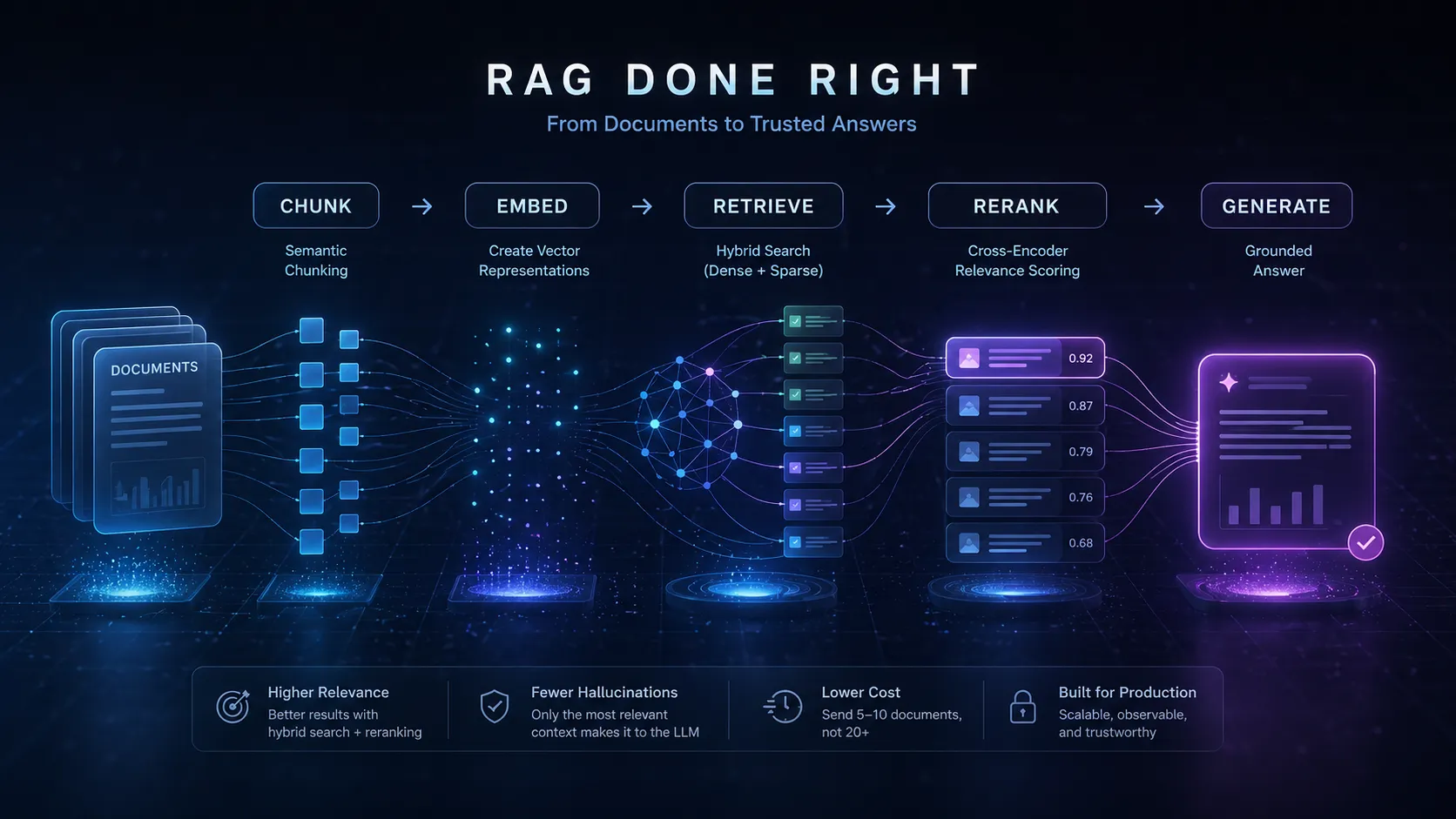
Most RAG tutorials show you how to chunk documents, embed them, and retrieve the top-k results. That works in demos. In production, it quietly fails and your LLM confidently makes things up from irrelevant context. I built Ragora, an advanced RAG system for financial document Q&A, to understand exactly where naive RAG breaks and what it actually takes to fix it. Here's what I learned.
TL;DR — Naive RAG fails in production because top-k vector retrieval returns irrelevant chunks that LLMs confidently hallucinate from. Hybrid retrieval + cross-encoder reranking + query decomposition fixes this systematically.
The Problem With Naive RAG
Naive RAG has a predictable set of failure modes. Ask it to compare Q3 2024 revenue against Q3 2025, and it retrieves documents about both time periods but can't distinguish between them because fixed-size chunks cut across topic boundaries. The user query 'how did margins improve?' doesn't match 'gross profit expanded 450bps YoY' because the vocabulary is different. And all 20 retrieved documents get dumped into the LLM context, including 15 that are irrelevant.
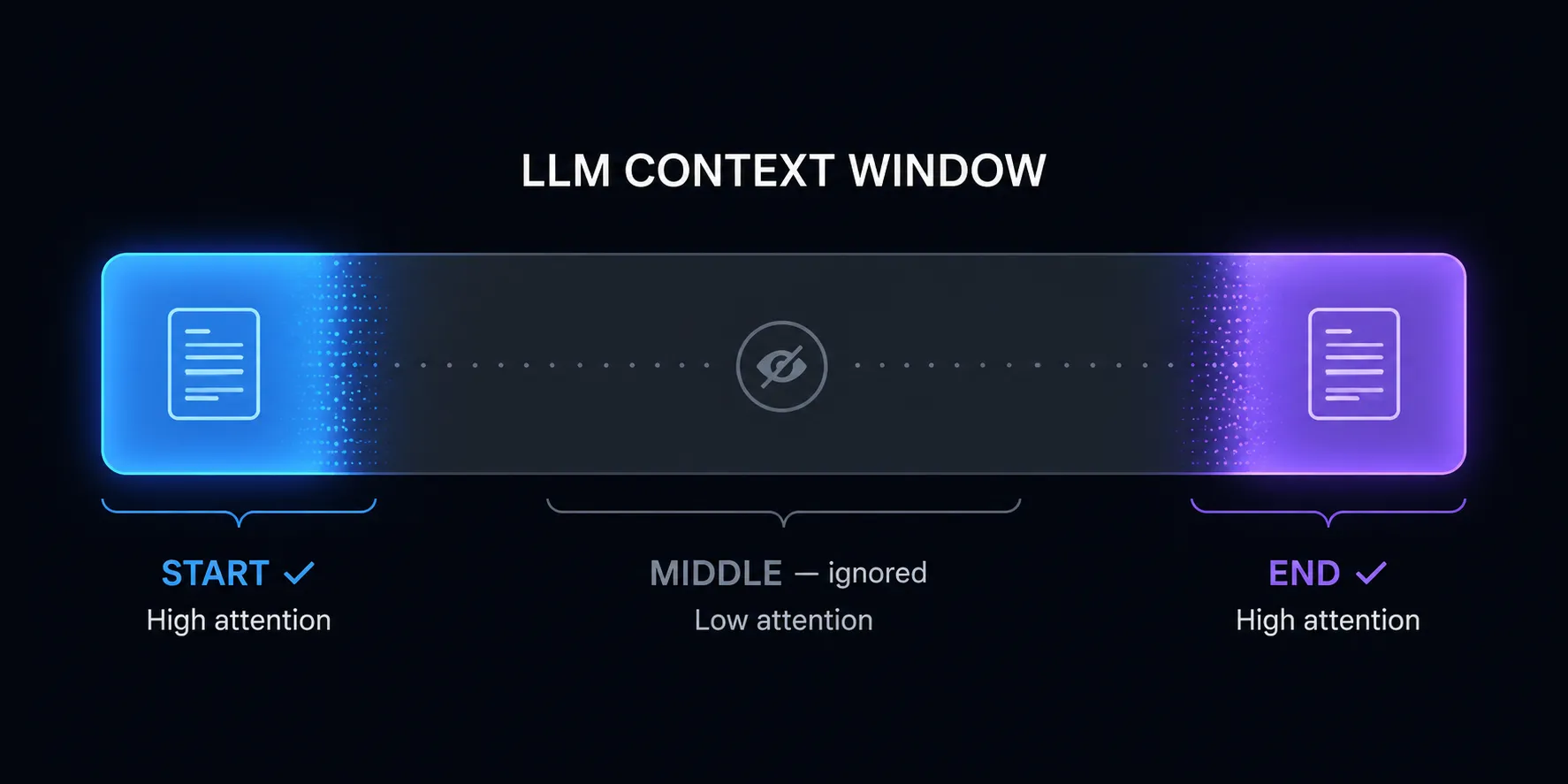
Research calls this the 'Lost in the Middle' problem: LLMs pay most attention to the beginning and end of their context window. Critical information buried in the middle of a 20-document context gets ignored even if it was retrieved correctly.
Advanced RAG is the engineering response to each of these failure modes. Let me walk through the five components that actually matter.
1. Semantic Chunking Stop Splitting at Arbitrary Sizes
Fixed-size chunking (every 500 tokens, full stop) is the RAG equivalent of cutting a book apart with a paper trimmer you'll slice sentences, paragraphs, and arguments in half. Semantic chunking does it differently: it embeds each sentence, computes cosine distance between adjacent sentences, and only inserts a chunk boundary when the topic actually shifts.
But there's a second problem: even perfectly-formed small chunks lose context when retrieved in isolation. 'Revenue was $3.1B' means nothing without the surrounding paragraph. The solution is a Small-to-Big strategy: index small child chunks (100 tokens) for precision, but when a child chunk matches a query, retrieve its full parent document (1000 tokens) for the LLM. You get accurate matching and complete context.
- Child chunks: ~100 tokens small enough for precise semantic matching
- Parent chunks: ~1000 tokens full context delivered to the LLM
- Overlap: 20 tokens at chunk boundaries to avoid missing split sentences
2. Hybrid Search Dense + Sparse Signals
Vector search is powerful, but it has a blind spot: it doesn't distinguish between 'Q3 2024' and 'Q3 2025' because their embeddings are nearly identical. BM25 (keyword search) is the opposite it matches 'Q3 2024' exactly, but misses paraphrases like 'third quarter last year.' The right answer is to run both in parallel and combine their results.
Reciprocal Rank Fusion (RRF) is the mathematically clean way to merge two ranked lists without worrying about whether cosine similarity scores (0–1) and BM25 scores (unbounded) are on the same scale. For each document, you sum up 1/(k + rank) across every list it appears in, where k=60 is a dampening constant. Documents that rank well in both systems win. Documents that only appear in one list get a smaller boost.
def reciprocal_rank_fusion(vector_results, bm25_results, k=60):
    rrf_scores = {}

    for rank, doc in enumerate(vector_results, start=1):
        rrf_scores[doc.id] = rrf_scores.get(doc.id, 0) + 1 / (k + rank)

    for rank, doc in enumerate(bm25_results, start=1):
        rrf_scores[doc.id] = rrf_scores.get(doc.id, 0) + 1 / (k + rank)

return sorted(rrf_scores.items(), key=lambda x: x[1], reverse=True)3. Two-Stage Reranking Precision After Recall
Hybrid search gets you 100 candidates. That's still too many to send to the LLM you'd hit the 'Lost in the Middle' problem immediately. Reranking is the filtering step that turns 100 noisy candidates into 5–10 genuinely relevant documents.
Stage 1 (bi-encoder) encoded your query and documents independently that's how you got your 100 candidates fast. Stage 2 (cross-encoder) is different: it feeds the query and document together through a single model, letting the model directly compare every word in both. This is far more precise, but it can't be pre-computed, so you only run it on your shortlist.
- Bi-encoder (Stage 1): ~20-50ms, recall-optimized casts a wide net
- Cross-encoder (Stage 2): ~150-300ms, precision-optimized scores every (query, doc) pair jointly
- Managed option: Cohere Rerank v3.0 (best quality, no GPU needed)
- Self-hosted option: BGE-reranker-v2-m3 (open source, runs on T4 GPU)
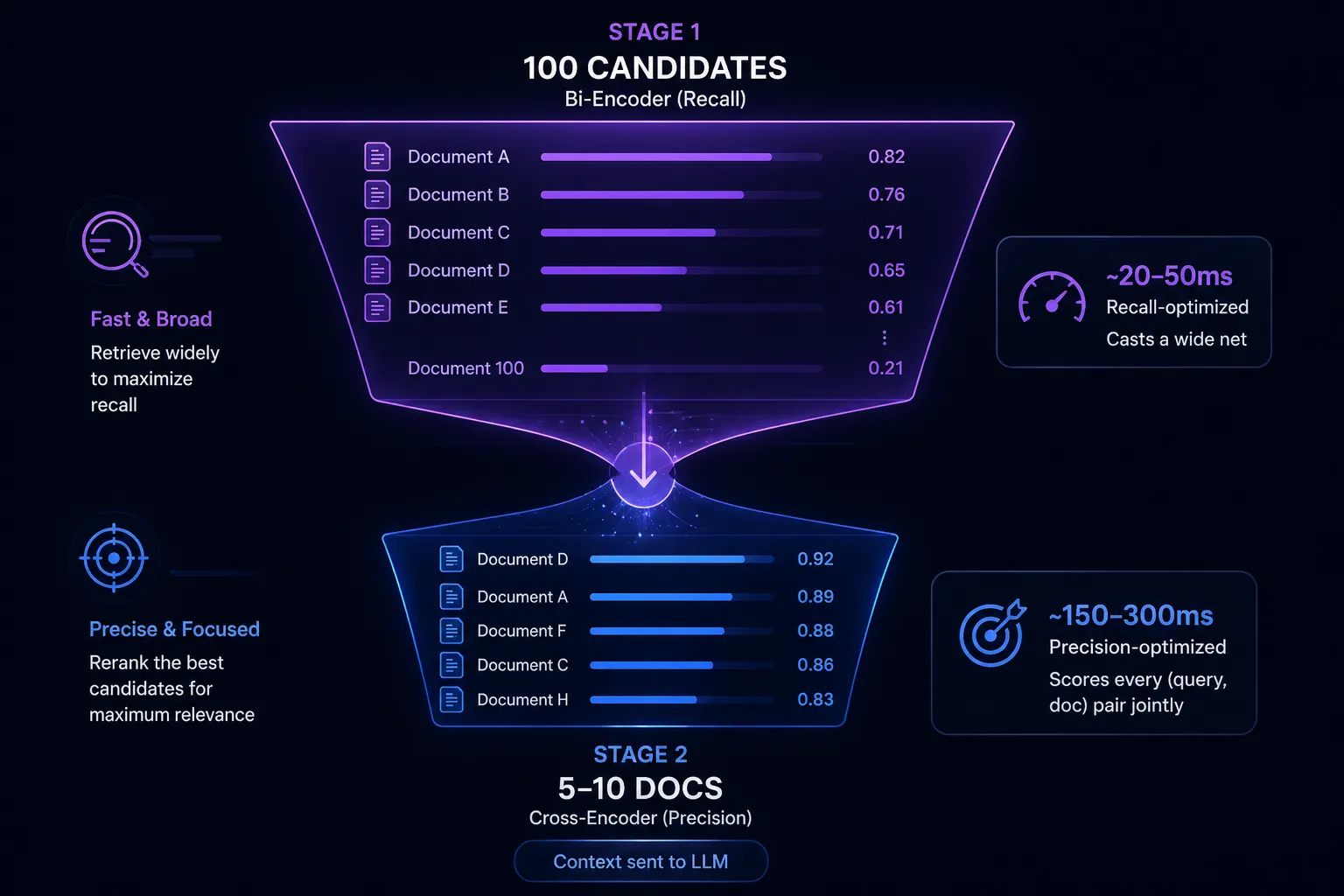
In Ragora's tests, reranking dropped the average retrieved context from 10 noisy documents to 5 highly relevant ones with an average relevance score of 0.89. That directly improves LLM answer quality and eliminates the 'Lost in the Middle' risk.
4. Query Transformation Fix the Input Before It Hits the Database
Users ask messy questions. 'How did the company do last quarter compared to the year before?' which quarter? Which year? 'What's the profit situation?' the documents say 'net income.' Raw queries fail because of vocabulary mismatch and temporal ambiguity.
Query decomposition uses a fast LLM (GPT-4o-mini or Gemini Flash) to transform a single vague question into 3–5 precise sub-queries before anything touches the vector database. Each sub-query retrieves independently, results are deduplicated, and the final reranking happens against the original question for coherence.
The result: 'How did the company perform in Q3 compared to last year?' becomes five atomic queries covering revenue, margins, EBITDA, gross profit, and key growth drivers. Each retrieves 5–9 unique documents. After deduplication and reranking, the LLM gets the 10 best documents covering all dimensions of the question.
5. RAG vs. Long-Context When Not to Use This
Gemini's 2M token context window is genuinely impressive, and it's tempting to just stuff everything in. But the economics don't hold up at scale.
- Advanced RAG at 1000 queries/day: ~$0.15/day (50K tokens)
- Long-context at 1000 queries/day: ~$6.00/day (2M tokens full corpus)
- That's 97% cheaper and the gap grows with query volume
Use long-context when you're doing one-time analysis on a static document set and complex reasoning links are hard to predict. Use Advanced RAG when your corpus exceeds 500K tokens, your data changes frequently, you're handling sensitive data (only minimal context leaves your system), or you're processing millions of queries in production.
The Stack That Makes It Work
For a production Advanced RAG system in 2026, here's what the component decisions actually look like:
- Vector DB: Qdrant (Rust-based, native hybrid search, metadata filtering for fiscal year/quarter tags)
- Embedding: text-embedding-3-large for general docs, voyage-finance-2 for pure financial document corpora
- Reranker: Cohere Rerank v3.0 for managed, BGE-reranker-v2-m3 for self-hosted
- Query Transform: GPT-4o-mini or Gemini Flash fast, cheap, deterministic at low temperature
- Orchestration: LlamaIndex for complex retrieval workflows
- Monitoring: LangFuse for RAG-specific tracing and hallucination detection
Final Thoughts
Naive RAG isn't wrong it's just incomplete. The jump to production quality isn't a single fix; it's five compounding improvements: semantic chunking preserves meaning, hybrid search catches what vector search misses, reranking eliminates noise before the LLM sees anything, query transformation fixes ambiguous input, and the parent-document strategy ensures context is never lost at retrieval time.
The payoff is measurable. Queries that naive RAG answered with confident hallucinations become grounded, accurate responses. And at production scale, the token cost savings from only sending 5–10 documents to the LLM instead of 20+ make the pipeline economics significantly better too.
Need an AI engineer for your project? I build RAG systems, LLM integrations, AI agents, and SaaS backends. Reach me at prayagbagthariya.vercel.app/hire-me or prayag129787@gmail.com.
Frequently Asked Questions
What is the difference between naive RAG and advanced RAG?
Naive RAG splits documents into fixed-size chunks, embeds them, and retrieves the top-k by vector similarity. It fails in production because chunks cut across topic boundaries, vocabulary mismatches cause relevant documents to be missed, and irrelevant results pollute the LLM context. Advanced RAG adds semantic chunking, hybrid search, reranking, query transformation, and parent-document retrieval to address each of these failure modes systematically.
Why does my RAG system give confident wrong answers even when the answer is in my documents?
The most common cause is retrieval failure — the right document exists but isn't being retrieved. This happens due to vocabulary mismatch (the query uses different words than the document), poor chunking (the answer is split across chunk boundaries), or context window pollution (too many irrelevant documents dilute the relevant ones). Hybrid search, semantic chunking, and reranking address each of these root causes.
What is semantic chunking and why is it better than fixed-size chunking?
Fixed-size chunking splits text every N tokens regardless of content, often cutting mid-sentence or mid-argument. Semantic chunking detects natural topic boundaries in the text and splits there instead, keeping coherent ideas together. This means each chunk represents a complete thought, which significantly improves both retrieval accuracy and the quality of context provided to the LLM.
What is a reranker and when should I add one to my RAG pipeline?
A reranker is a cross-encoder model that scores the relevance of a query and document together — more accurate than vector similarity alone but too slow to run against an entire corpus. Add one after your initial retrieval (top-20 candidates) to select the best 5–10 documents before they reach the LLM. Rerankers typically improve answer quality significantly, especially on complex or ambiguous queries.
What is the parent-document retrieval strategy in RAG?
Parent-document retrieval addresses a fundamental tension: small chunks retrieve more precisely, but large chunks give the LLM better context. The solution is to embed and retrieve small chunks, but then replace each retrieved chunk with its larger parent document before sending to the LLM. This gives you the retrieval precision of small chunks with the context richness of larger document sections.
Continue reading
Get updates directly in your Google Search feed
Add this publication as a preferred source to highlight articles in Top Stories and AI Overviews.